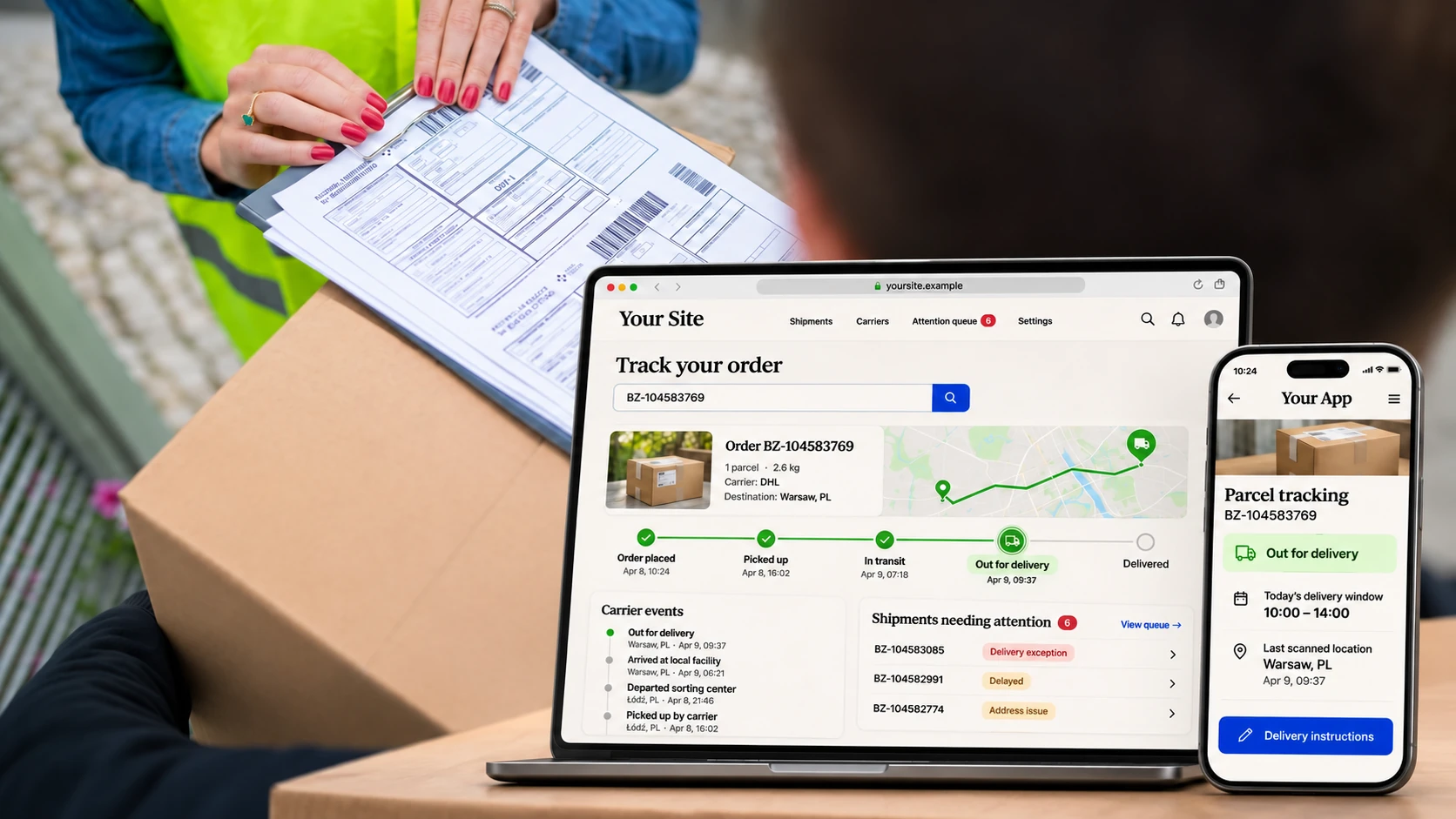
A customer asks where an order is, while the merchant checks several carrier sites and finds conflicting labels. Your service could bring the available events together and identify the shipment needing a human follow-up, helping the business communicate what is known without inventing an arrival promise.
A business you can
picture.
Offer shipment-tracking software to merchants using several delivery providers. Bring provider events into a customer-facing page and an internal queue for shipments that need attention.
Who would be glad
you built it?
Merchants using several carriers
Review shipment status in one place.
Customer support teams
Investigate exceptions and answer enquiries.
Customers tracking an order
Understand the latest reliable update.
Where the money
could come from.
Merchants could pay a subscription based on a clearly defined shipment volume or service scope. Integration and setup can be separately priced. Carrier access, notifications, support and maintaining status mappings create continuing costs; the service sells visibility and coordination rather than guaranteeing carrier performance or delivery times.
The part you could
make your own.
A useful exception queue could distinguish your product. Helping a merchant recognise the few shipments needing attention and communicate honestly may be more valuable than a decorative tracking page. Test the support team's next action, not the number of events collected.
An angle to test with the people you want to serve.Start with something
worth using.
Start with one merchant type and a small set of supported carriers. Connect order references, display source-dated events and queue exceptions for staff. Add customer notifications only after the underlying status mapping is reliable.
- Carrier status records and tracking pages
- Customer notification preferences
- Delayed-shipment review and support notes
Give the promise
something to stand on.
You need dependable carrier data access and a clear interpretation of event statuses. Missing or delayed updates, reference mismatches and customer communication require careful handling; the software should show uncertainty rather than manufacture precision.
Carrier data quality, connection failures and customer privacy need ongoing management. A predicted arrival should be labelled appropriately. Staff need a clear route for handling a missing or disputed shipment.
Let a small beginning
teach you something.
Use sample shipments to test ordinary and delayed event sequences, then pilot with a willing merchant. Compare the displayed status with carrier evidence and ask support staff whether the exception view helps them choose the next action.
Can support staff explain the latest verified shipment event and identify what needs checking without implying a delivery certainty they do not have?
Look for these signs
- Updates retain source and timestamp
- Exceptions reach a responsible reviewer
- Customer messages reflect available evidence
A little more
clarity.
Can the service show live location for every parcel?
Only when the carrier supplies appropriate reliable information. Many integrations provide events rather than continuous location, so label the view accurately and avoid drawing a live-looking map from incomplete data.
What if a carrier stops sending updates?
Show the last confirmed event and the missing-data condition, then route the shipment for investigation. An old status should not keep generating confident arrival messages simply because no new event has arrived.
AfterShip is a reference for shipment tracking software.
Now picture it
with your name on it.
Your people. Your priorities. The version you keep thinking about. Answer a few questions and leave with a starting plan you can keep.
Free to explore. No account or email needed for your starting plan.