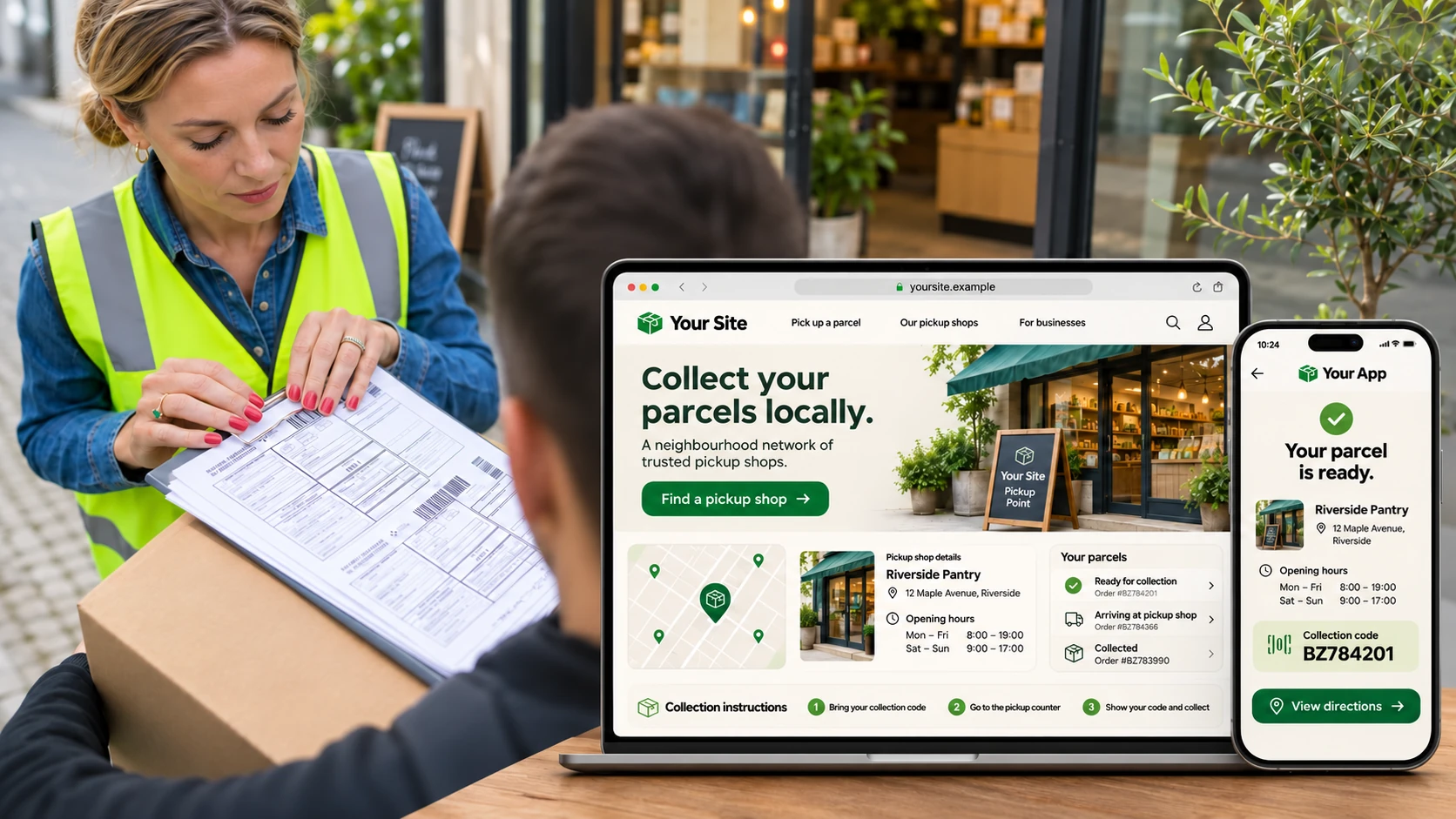
A customer cannot wait at home all day, while a nearby shop is open at useful hours. That convenient idea still needs more than a counter. Your network could give carriers, hosts and recipients a shared process for arrival, storage and collection, so everyone knows where the parcel is and who has accepted it.
A business you can
picture.
Start with a small host network and one carrier relationship. Each parcel receives a reference, the host records receipt and the customer gets clear instructions for an authorised collection.
Who would be glad
you built it?
Customers needing flexible collection
Clear location, hours and pickup instructions
Local host shops
An organised parcel-handling role with agreed payment
Carriers and merchants
A traceable final handover arrangement
Where the money
could come from.
Carriers or merchants could pay a per-parcel service fee, with an agreed portion paid to the host. The remaining revenue must cover software, support, host coordination and loss or dispute handling. Price the actual storage and staffing work, and state which party carries responsibility at each stage rather than treating the host’s counter as free capacity.
The part you could
make your own.
Your proposed difference is accountability around a convenient location. A host could see exactly what it accepted and a recipient could understand the collection rules before travelling to the shop.
An angle to test with the people you want to serve.Start with something
worth using.
Trial a small host group in one area. Record parcel arrival, notify recipients, verify collection through the agreed process and preserve handover receipts. Explain uncollected parcels and mismatched records before launch.
- Show current opening hours and host capacity.
- Record receipt and the authorised collection event.
- Handle uncollected or damaged parcels through a clear process.
Give the promise
something to stand on.
You need suitable host premises and dependable carrier agreements. Define custody, storage limits, collection checks and support, and protect recipient details from unnecessary access at the host location.
Define custody, storage limits, identity checks and support responsibilities. Protect recipient details, and use a clear process when the parcel or collection record does not match.
Let a small beginning
teach you something.
Partner with a carrier and a few suitable shops on a limited parcel flow. Follow each handover and test the response to a harmless record mismatch, checking whether staff know who must resolve it.
Can the network trace a parcel through arrival and collection with the correct recipient and responsible custodian identified?
Look for these signs
- Hosts acknowledge actual parcel receipt
- Collection follows the agreed identity process
- Mismatches reach a clear support owner
A little more
clarity.
Can any retailer act as a host?
A host needs suitable space, reliable opening hours, trained staff and agreed responsibilities. Review the real operation before presenting a location as ready to receive parcels.
What happens to an uncollected parcel?
Set a clear holding period and return or escalation process with the carrier. Recipients and hosts should understand those terms before the parcel enters the network.
What should my first version focus on?
Start with the first test described here, then build around the part people actually use and would pay to keep.
Now picture it
with your name on it.
Your people. Your priorities. The version you keep thinking about. Answer a few questions and leave with a starting plan you can keep.
Free to explore. No account or email needed for your starting plan.