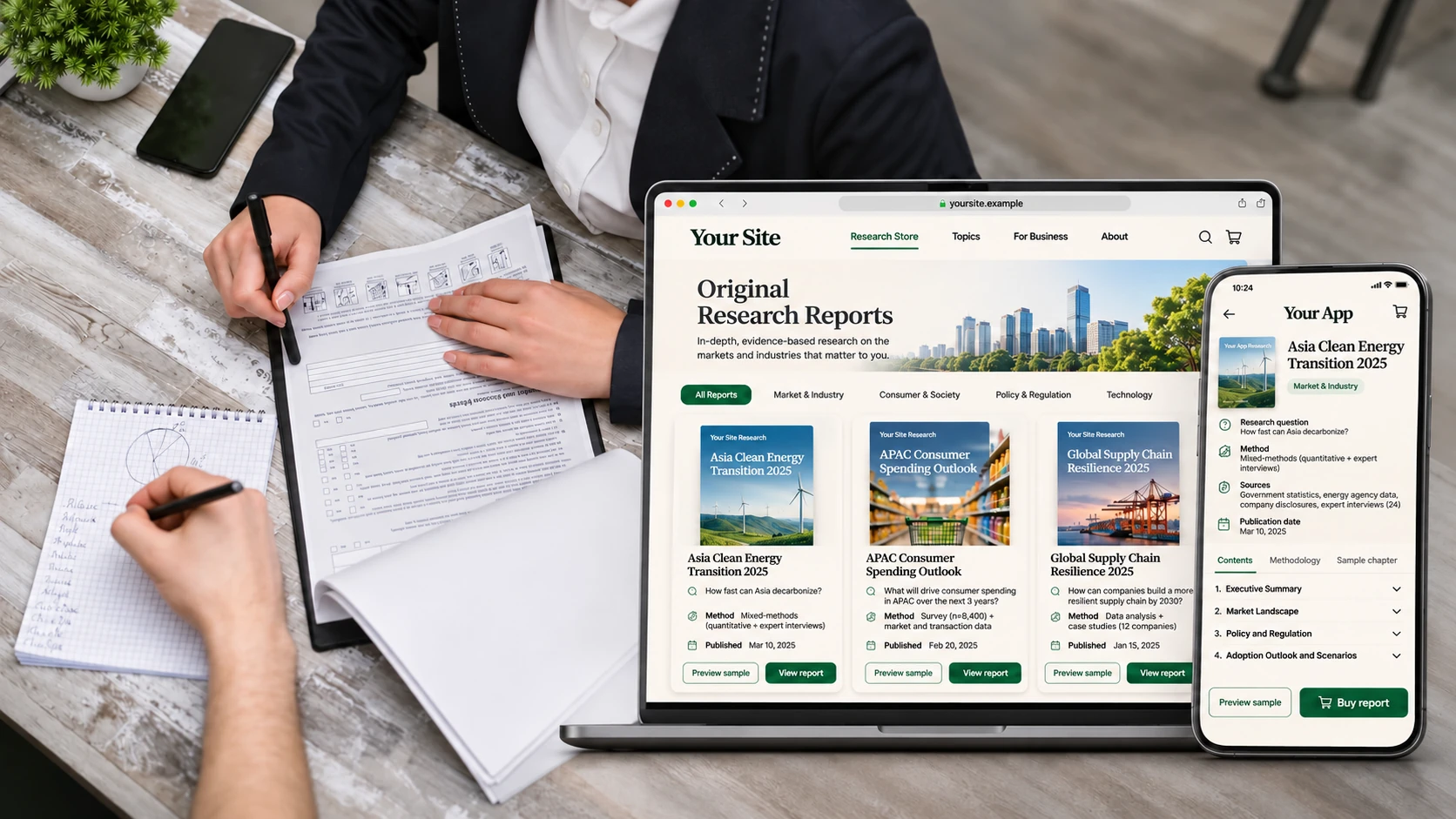
A business owner needs to understand a narrow market question but cannot commission a full research team. Your report could offer a well-defined investigation with visible sources, dates and limits. The value is a useful piece of evidence they can interpret, not an impressive-looking document that hides how conclusions were reached.
A business you can
picture.
Create original research products for a specific audience. Explain the question, method, sources and date of each report, then let customers understand the scope before buying.
Who would be glad
you built it?
Business decision-makers
Explore a defined market or operating question.
Professional advisers
Use clearly licensed research with clients.
Small strategy teams
Access focused evidence without commissioning everything.
Where the money
could come from.
Customers could buy a defined report with stated access and usage rights. A maintained series can later support subscriptions, while commissioned research has its own scope. Source access, research time, expert review and updates all affect the economics; a report's high price needs a useful, clearly explained research service behind it.
The part you could
make your own.
A precise question and transparent method could make your publication distinctive. Test whether buyers value a carefully bounded answer more than a broad market overview full of unsupported forecasts. Useful limits can strengthen confidence in the work.
An angle to test with the people you want to serve.Start with something
worth using.
Choose one audience and one recurring question. Publish a sample, contents, method summary and date, then sell a focused report with clear usage rights. Separate commissioned studies from off-the-shelf research so buyers understand the scope.
- Report previews and methodology notes
- Individual and team licences
- Updates and customer research enquiries
Give the promise
something to stand on.
You need research expertise, appropriate source rights and a transparent method. Original analysis, fact checking and updates require real work; the report should make its limitations as easy to find as its headline conclusions.
Research quality, source rights and correction procedures are essential. Separate measured findings from estimates and interpretations. Avoid selling reused public material as if it were proprietary field research.
Let a small beginning
teach you something.
Ask intended buyers which decision they are struggling to inform and what evidence they currently use. Test a sample section, then a paid report with a small audience, asking how they used it and where it was insufficient.
Can the buyer explain what question the report answers, what evidence supports it and what it does not establish?
Look for these signs
- Methods and sources are traceable
- Buyers understand the report's scope
- Corrections and updates have a clear policy
A little more
clarity.
Can the report guarantee a good business decision?
No. It provides evidence and analysis within a defined scope. Buyers still need to consider their own circumstances and other information; uncertainty and limitations should remain visible rather than disappear in the sales copy.
May one purchase be shared across a company?
Explain the licence before checkout. Individual, team and client-facing uses can be different offers, and buyers should know whether updates, redistribution or excerpts are included without negotiating after purchase.
Research and Markets is a reference for report marketplaces.
Now picture it
with your name on it.
Your people. Your priorities. The version you keep thinking about. Answer a few questions and leave with a starting plan you can keep.
Free to explore. No account or email needed for your starting plan.