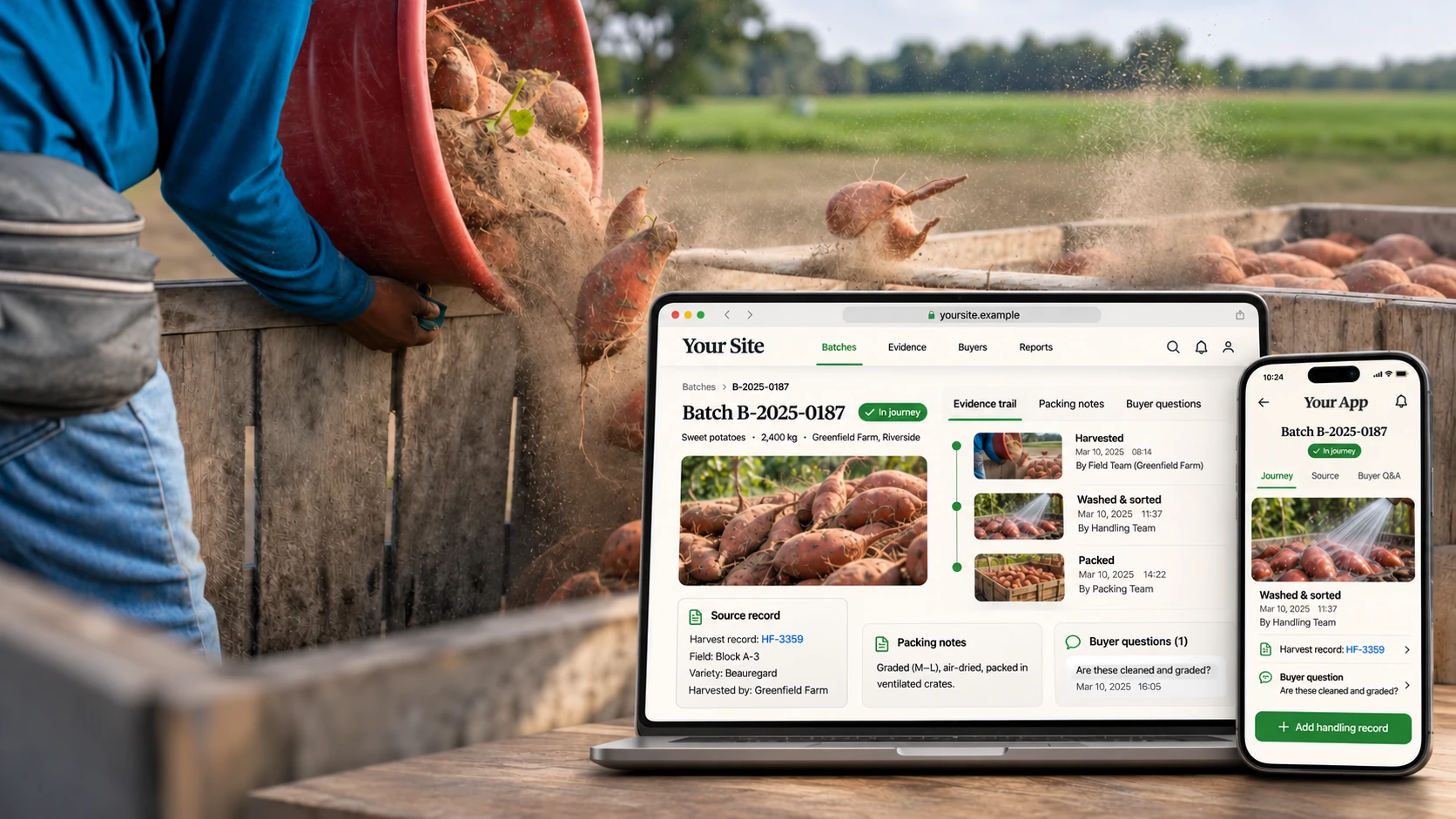
A buyer asks where a batch came from and what happened before delivery. The grower has one note, the handler has a receipt and the transporter remembers a change. Your service could connect the available records into a readable journey, making the known information useful and the missing parts visible.
A business you can
picture.
Begin with one crop and a short supply route. Each participant records the agreed details at its handover, while the batch retains a consistent reference and a history of attributed updates.
Who would be glad
you built it?
Grower groups and aggregators
A shared place for batch-related records
Produce buyers
A clearer route to evidence behind a supplier’s answer
Handlers coordinating handovers
Attributable records of their part of the journey
Where the money
could come from.
An aggregator or buyer could pay for workspace access and a defined onboarding service. The fee covers record organisation, user support and maintenance; collection of existing evidence can be separately scoped. The service should sell a clearer chain of information, not full traceability or certification when the underlying records remain incomplete or unverified.
The part you could
make your own.
Your proposed difference is readability for smaller operators. A buyer could see who recorded each step and what still needs confirmation, instead of receiving a polished summary that quietly removes uncertainty.
An angle to test with the people you want to serve.Start with something
worth using.
Choose one produce chain and a small set of agreed records. Connect batch identity, handovers and supporting documents, then show gaps plainly. Let responsible people correct entries while preserving the previous record.
- Keep a batch reference through each agreed handover.
- Record who supplied each piece of information.
- Show missing records and unresolved buyer questions.
Give the promise
something to stand on.
You need competent supply-chain partners to agree which records matter. Entries should identify their source and limits, with appropriate checking before making claims about origin, condition or certification.
Agree the required records with competent partners and verify claims appropriately. A digital entry shows what someone recorded; it does not independently prove the condition or origin of a product.
Let a small beginning
teach you something.
Work with a willing grower group and buyer on one actual batch. Ask a practical origin or handover question and follow the evidence together, recording where the answer is supported and where further confirmation is needed.
Can the buyer understand the batch’s recorded journey and identify which parts are supported, unconfirmed or missing?
Look for these signs
- Records identify their original sources
- Missing handovers remain visible
- Corrections preserve an understandable history
A little more
clarity.
Does a digital entry prove the produce’s origin?
No. It shows what someone recorded. Appropriate verification and real operating controls are needed before stronger claims can be made about origin, condition or authenticity.
How is this different from full traceability software?
The first offer can focus on organising the evidence smaller partners already have. Describe that limited scope honestly and only claim a complete chain when the actual records and process support it.
What should my first version focus on?
Start with the first test described here, then build around the part people actually use and would pay to keep.
Now picture it
with your name on it.
Your people. Your priorities. The version you keep thinking about. Answer a few questions and leave with a starting plan you can keep.
Free to explore. No account or email needed for your starting plan.