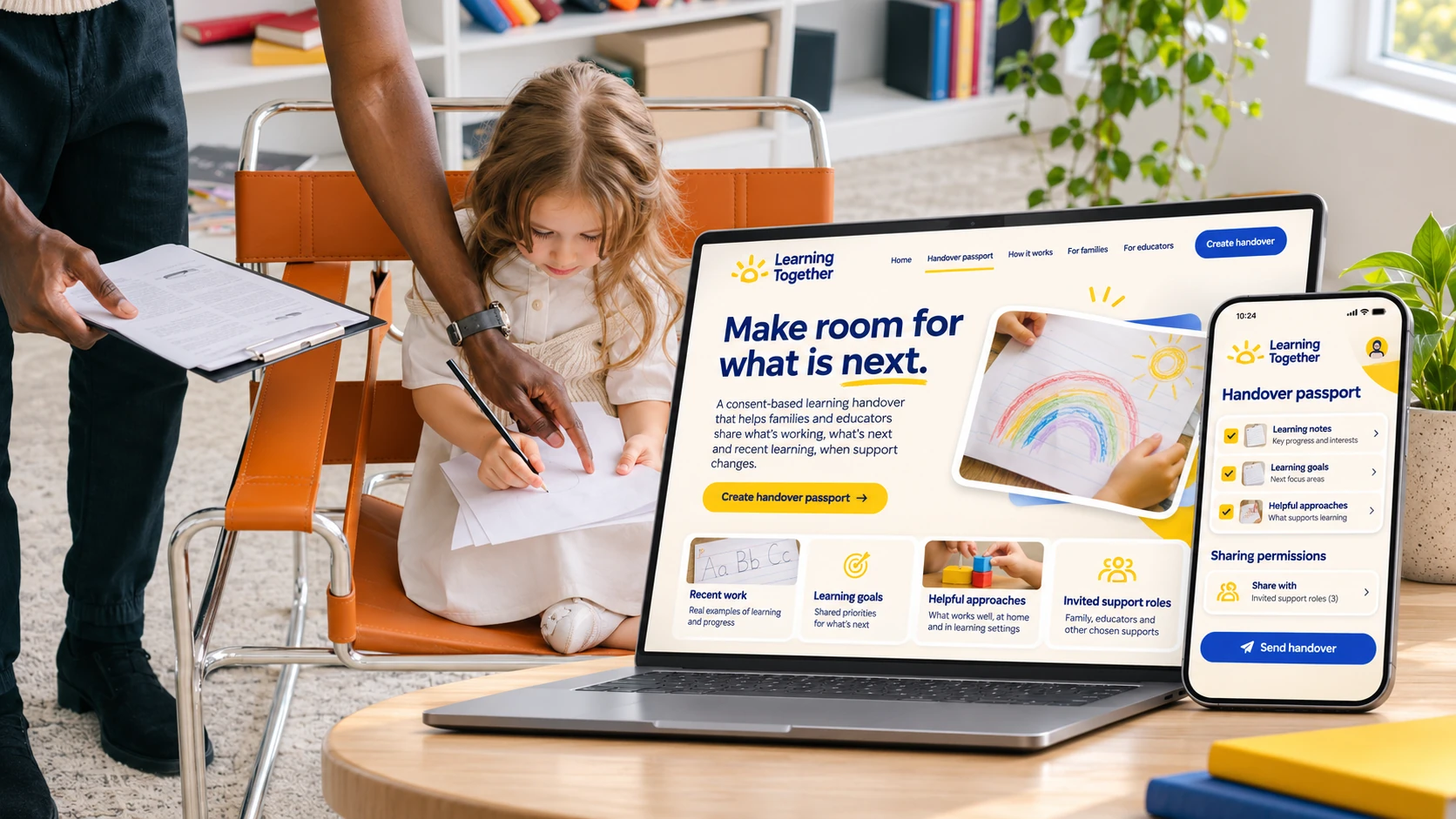
A learner moves to a new tutor and hears the same opening questions, while small achievements from the previous term disappear from view. You could create a handover service that carries useful context forward: goals, examples of work and approaches that helped, all shared with permission and room for a fresh understanding.
A business you can
picture.
Build a portable learning workspace controlled by the family or adult learner. Educators contribute short observations and examples that the owner chooses to share with the next provider.
Who would be glad
you built it?
Tutoring organisations
A practical transition record between educators
Families changing support providers
A supported way to share relevant learning context
Receiving educators
Dated observations and examples to inform their own assessment
Where the money
could come from.
A tutoring organisation could pay for learner workspaces within a defined transition programme. The fee covers secure access, setup and support. A separately priced assisted handover can help organise existing material. The service earns from continuity work, not from labelling a learner or claiming that a transferred record guarantees better educational results.
The part you could
make your own.
Your proposed edge is preserving progress without making every old observation permanent. Dated context and a learner’s own voice could help the next educator begin with care while still making an independent assessment.
An angle to test with the people you want to serve.Start with something
worth using.
Trial one transition pathway between tutors. Record current goals, selected work, useful approaches and the learner’s own view. Let the family and responsible educator review exactly what the receiving tutor can see.
- Capture goals and selected examples of work.
- Record approaches the learner found helpful.
- Share a limited handover with an expiry date.
Give the promise
something to stand on.
You need educators who can define useful handover information and families who understand the sharing choices. Observations should be attributed and revisable, with careful consent and access controls.
Consent, access and deletion need careful attention, especially for children. Keep observations attributed and dated; educators remain responsible for interpreting the information and planning instruction.
Let a small beginning
teach you something.
Invite two tutoring teams and consenting families to trial a small set of real transitions. Ask receiving educators which details influenced their first session and which information was unnecessary.
Does the handover help the receiving educator plan a useful first conversation while preserving the learner’s dignity and choice?
Look for these signs
- Shared observations have dates and authors
- Families understand what is transferred
- Educators identify useful context for the first session
A little more
clarity.
Is this a permanent label for the learner?
It should not be. Present observations in context, allow appropriate correction and avoid turning one educator’s note into a fixed judgement about a person’s ability.
Can schools or tutors share everything automatically?
Sharing needs an appropriate consent and access process. Select the information relevant to this transition and make the receiving party’s role clear rather than opening an entire record by default.
What should my first version focus on?
Start with the first test described here, then build around the part people actually use and would pay to keep.
Now picture it
with your name on it.
Your people. Your priorities. The version you keep thinking about. Answer a few questions and leave with a starting plan you can keep.
Free to explore. No account or email needed for your starting plan.