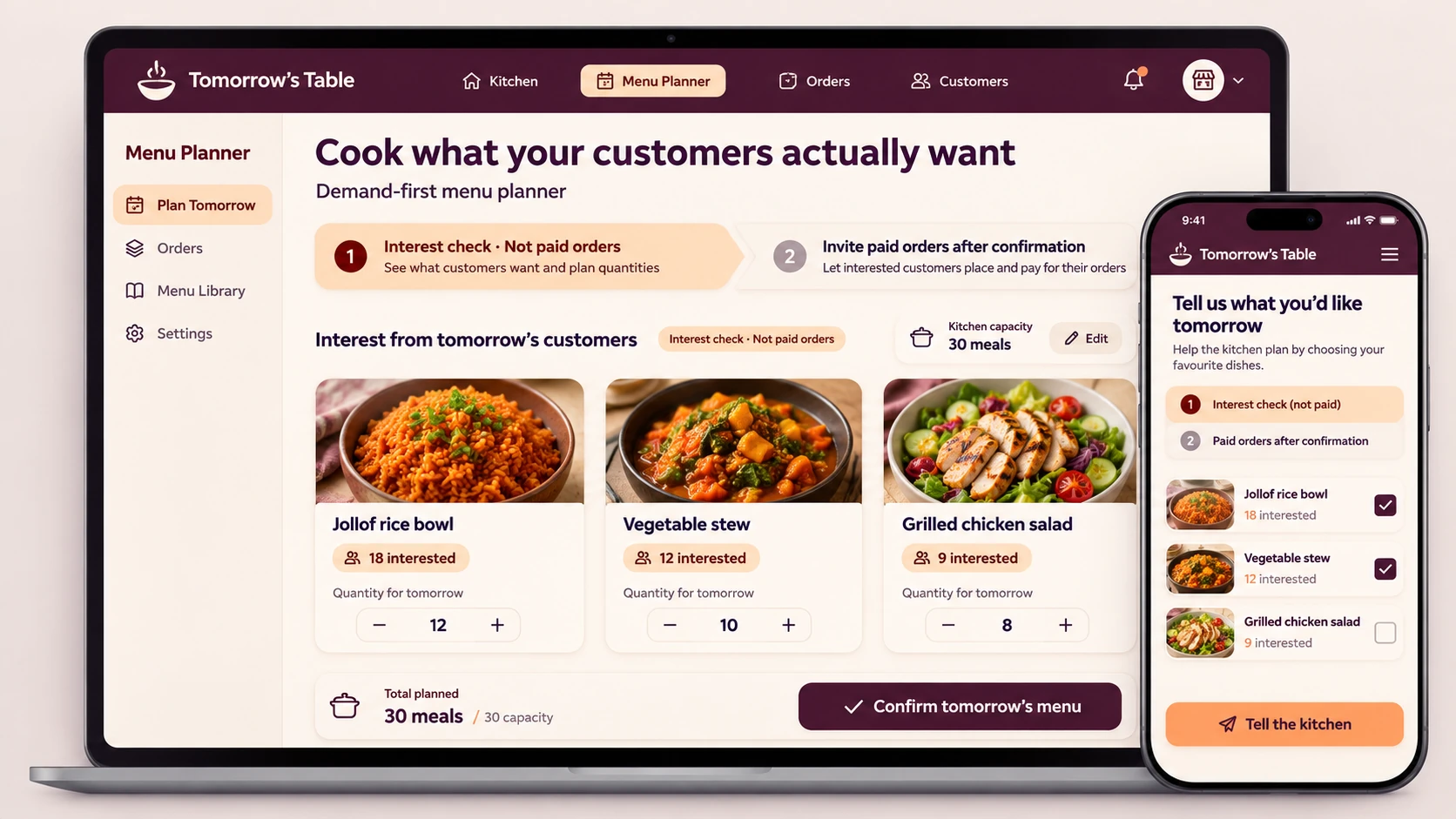
You are considering tomorrow's menu but only hear what customers wanted after the food is prepared. A planning feature could invite early interest in a few dishes, then let your kitchen confirm the actual offer. The important distinction is between a hopeful response and an order someone has committed to buying.
The kitchen chooses a menu from scattered requests and guesses how much of each dish customers may actually buy.
Customers express interest, the kitchen confirms a feasible offer, and paid orders remain a distinct step with clear quantities.
Where it could
make a difference.
Small kitchens
Collect early interest before finalising a menu.
Regular diners
Express preferences before ordering opens.
Food business planners
Compare interest with actual purchases.
Useful on: Food ordering website, Business portal.
What this could mean
for your business.
The feature can support preorders and repeat purchases while giving your planner another source of information. Any reduction in unused ingredients or preparation effort must be observed in real menu cycles. Include staff administration and messaging costs when deciding whether the planning benefit justifies keeping the feature.
Start with something
worth using.
Start with one menu cycle, a short list of dishes and an interest deadline. Let the kitchen review responses and publish the final offer separately before accepting orders.
- Possible dishes and quantities
- Kitchen review and confirmation
- Separate paid order invitation
Give the promise
something to stand on.
You need a responsible kitchen planner and clear menu ownership. Keep ingredients, availability and food information current, and decide how customers move from interest to a confirmed paid order.
Plan for messaging, menu updates, support and order connections. Staff need a way to correct quantities or withdraw an offer. The food business remains responsible for food safety, ingredients and allergen information.
How it fits what you already have
Check the menu and ordering system, customer consent for updates and how quantities become confirmed orders. The kitchen must control prices, availability and food information, with a route to correct or withdraw an offer.
Let a small beginning
teach you something.
Invite willing regulars to respond to one proposed menu. Compare those responses with completed orders and ask staff whether the extra planning work supplied a useful signal.
Does the early interest give your kitchen useful information without being mistaken for a firm order or production guarantee?
Look for these signs
- Interest and orders remain separate.
- Menu changes reach interested customers.
- Staff can compare responses with actual purchases.
A little more
clarity.
Should we cook every requested portion?
An expression of interest is not necessarily a purchase. The kitchen should decide how to use it, with paid preorders or another clear confirmation process where appropriate.
Can AI decide production quantities?
A later suggestion could assist a planner, but it would need reviewed inputs and visible uncertainty. Keep a person responsible for production decisions and food business obligations.
Can AI suggest how much to prepare?
It could offer an estimate based on previous orders. The kitchen would review it against current stock, capacity and uncertainty.
Does showing interest reserve a meal?
No. The customer needs a separate confirmation when the kitchen opens actual orders.
Too Good To Go connects customers with surplus food from businesses. It is an adjacent reference for matching supply and demand. This concept explores planning before production rather than finding buyers for existing surplus.
What would this change
in your business?
Your customers. Your working day. The part you would love to make easier. Answer a few questions and leave with a starting plan you can keep.
Free to explore. No account or email needed for your starting plan.