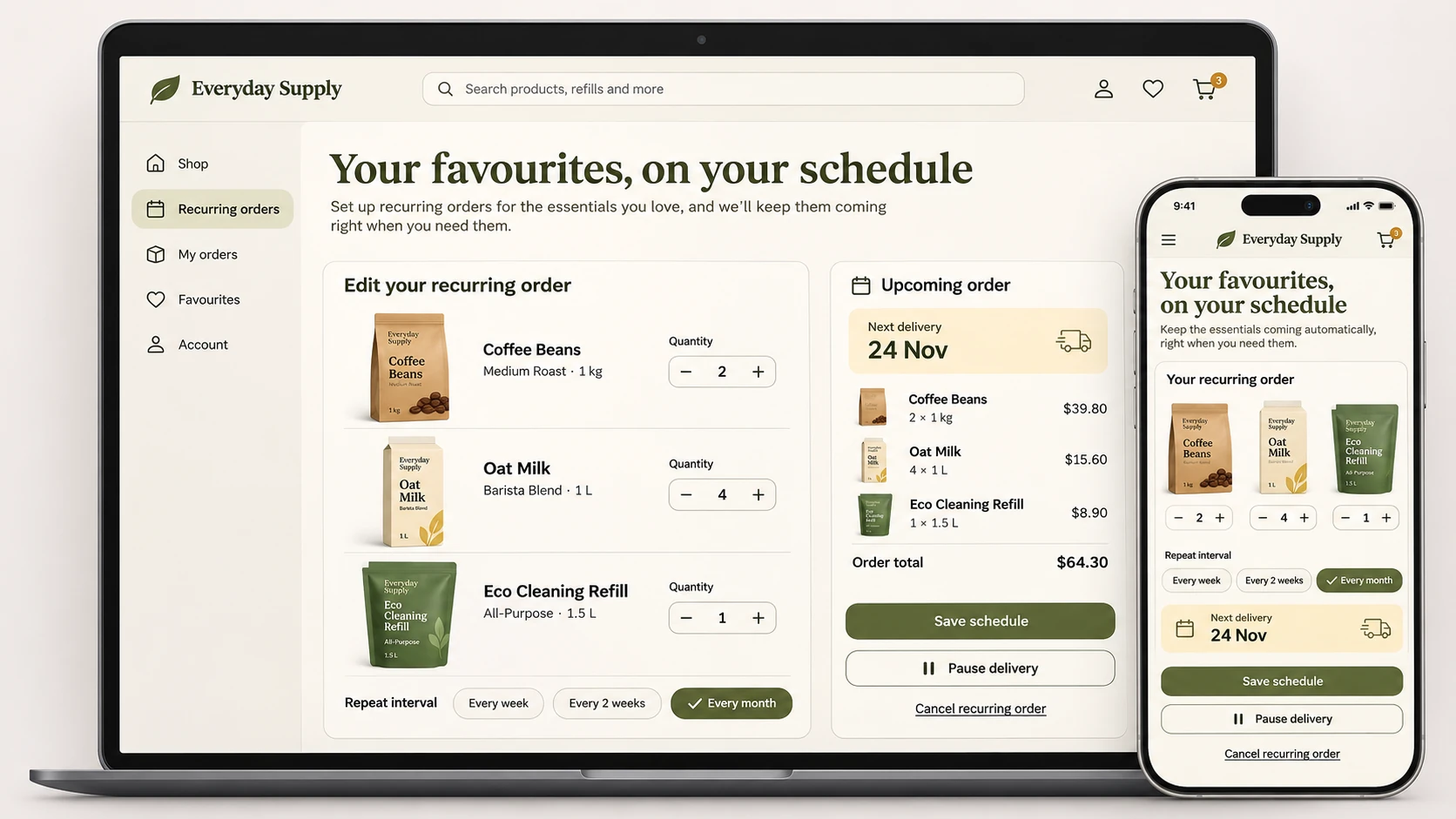
A customer buys the same essentials repeatedly but only remembers when the supply is nearly finished. A recurring-order feature could make that routine easier, provided they can see the next basket, price and date before it happens. Your business gains a planning signal while retaining the responsibility to fulfil every confirmed order.
Customers remember to reorder individually, and your team repeatedly rebuilds familiar baskets and explains the next delivery arrangement.
Customers choose a repeat pattern, review the upcoming order and can pause or change it before the agreed cutoff.
Where it could
make a difference.
Regular product suppliers
Offer a convenient repeat purchase.
Food box businesses
Let households review the next delivery.
Wholesale sellers
Support predictable replenishment with customer control.
Useful on: Online store, Food ordering website, Wholesale portal.
What this could mean
for your business.
Repeat orders can support continuing product sales and make purchasing more convenient. The business must still cover goods, fulfilment, payment costs and support. Assess fulfilled cycles and customer satisfaction alongside pauses and cancellations, rather than assuming that automatic billing creates dependable long-term revenue by itself.
Start with something
worth using.
Begin with a small repeat-purchase range, chosen intervals and upcoming-order summaries. Include pause, skip and cancellation. Test the full change cycle before adding mixed boxes or complex plan rules.
- Repeat interval and quantity
- Upcoming order summary
- Pause and cancellation options
Give the promise
something to stand on.
You need dependable supply, clear payment consent and someone responsible for changes. Decide how unavailable products, price changes and failed payments are handled before inviting customers to repeat automatically.
Stock, payment failures, price changes and delivery changes need clear handling. Customers should understand the commitment before the first recurring order begins.
- Reliable supply and delivery
- Clear recurring payment consent
- A change and support process
How it fits what you already have
Check stock, recurring payment support, customer accounts and delivery scheduling. Define the system that owns the next order and test how changes, failed renewals and cancellations reach fulfilment without duplicate shipments.
Let a small beginning
teach you something.
Invite willing repeat customers to try one suitable product cycle. Ask whether the next order is understandable and review every change, pause or failed renewal with the fulfilment team.
Can the customer see and control the next order before it becomes a commitment your business must fulfil?
Look for these signs
- Upcoming orders show clear contents and timing.
- Pauses affect the correct cycle.
- Failed payments have a visible resolution.
A little more
clarity.
Must the price stay fixed forever?
That depends on the terms you offer. Any change needs a clear communication and consent process appropriate to the arrangement, so customers are not surprised by an unexplained charge.
Does a subscription remove stock planning?
No. It provides another input to planning. You still need accurate supply, fulfilment capacity and a transparent way to handle unavailable items or changed delivery arrangements.
Could this work with my existing website?
We would check how your current website is built, what it already does and which services need to connect. That helps us choose a suitable addition and avoid paying twice for something you already have.
What would this change
in your business?
Your customers. Your working day. The part you would love to make easier. Answer a few questions and leave with a starting plan you can keep.
Free to explore. No account or email needed for your starting plan.