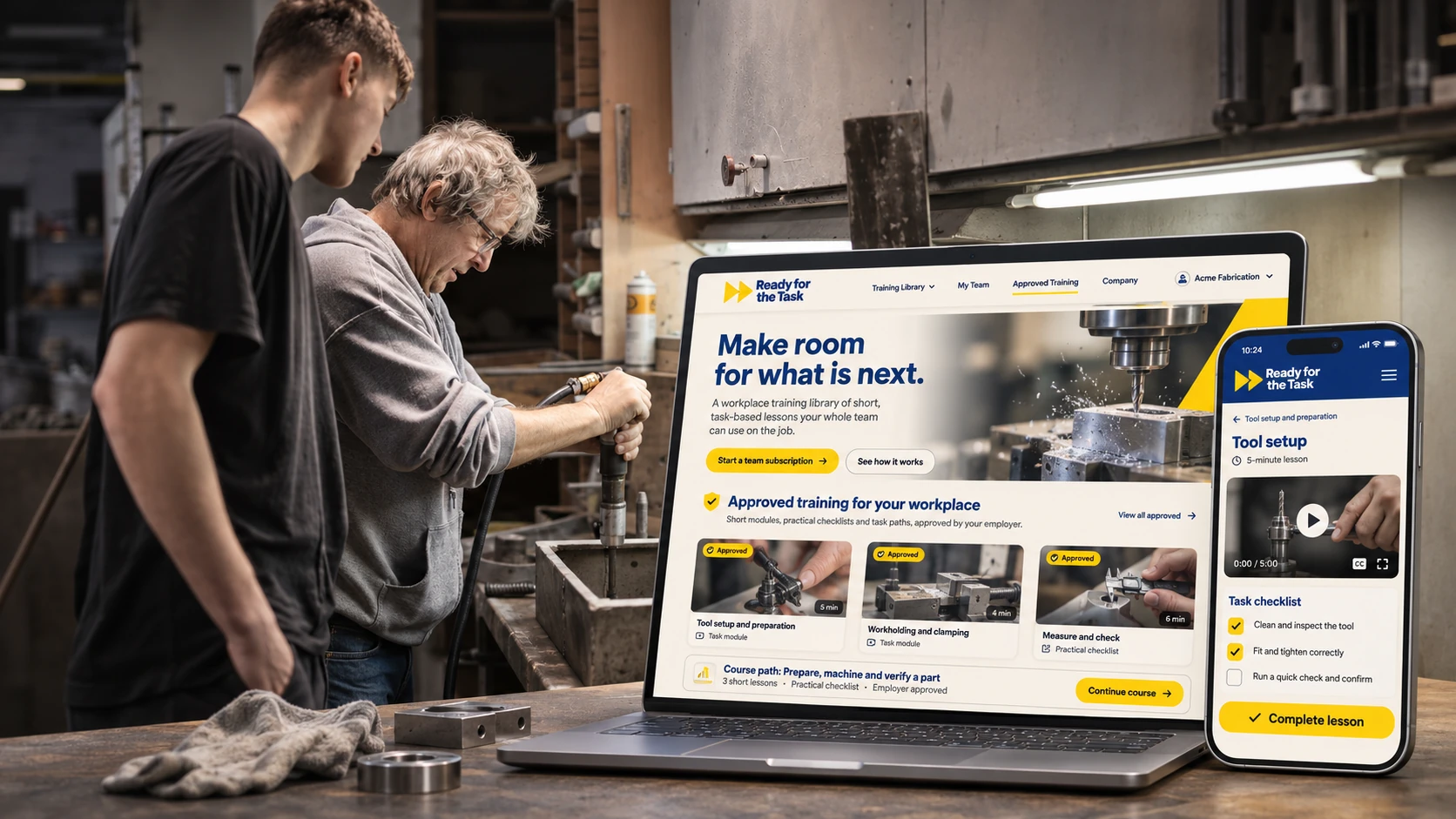
A new team member is about to perform a task alone and remembers only part of the demonstration. Asking again feels awkward, but guessing could create rework. Your library could offer the employer-approved steps, a short example and a clear person to contact when the situation falls outside the guide.
A business you can
picture.
Create a training subscription for a defined industry or sell a learning workspace to employers. Organise short lessons around real tasks and make it clear which material the employer has approved.
Who would be glad
you built it?
New employees
Revisit essential task instructions.
Team supervisors
Maintain consistent approved guidance.
Multi-location employers
Share training across similar roles.
Where the money
could come from.
Employers could buy a team licence for a defined training collection or workspace. Assisted content preparation can be separately priced. Teaching expertise, updates, support and employer onboarding cost time; the subscription should explain whether it includes ready-made lessons, publishing tools or both, since those are different promises.
The part you could
make your own.
A role-specific collection organised around real questions could stand out. Test whether a short guide found at the moment of need is more useful than a large course catalogue staff cannot connect to today's work.
An angle to test with the people you want to serve.Start with something
worth using.
Choose one role and its essential first tasks. Publish short approved guides, a simple learning path and acknowledgements of review. Keep workplace-specific policies separate from general teaching content so responsibility stays clear.
- Role-based learning paths
- Short lessons and practical checks
- Manager assignments and completion records
Give the promise
something to stand on.
You need either credible industry teaching material or a service for helping employers organise their own knowledge. Someone must own updates so a polished lesson does not remain online after the working process changes.
Keep training content current and record its owner. Completion is a record of participation, not automatic proof of competence. Managers need a way to confirm practical readiness where the task requires it.
Let a small beginning
teach you something.
Pilot with a supervisor and a few recent starters. Ask learners to find the answer to a real task question, then observe where the material still needs local explanation or a better example.
Can a new employee find the approved next step without relying on memory or interrupting the same colleague repeatedly?
Look for these signs
- Guides have named owners and review dates
- Learners find relevant task instructions
- Supervisors identify gaps from real questions
A little more
clarity.
Does completing a lesson prove competence?
It shows the recorded activity, not necessarily safe or skilled performance. Employers may need observation, practice or formal assessment for particular tasks. Make those distinctions clear in reports and training claims.
Who keeps company-specific lessons current?
Agree an owner and review process with the employer. Your service can prompt updates or provide editing support, but the organisation should approve instructions that describe its own policies and operations.
TalentLMS is an example of workplace learning software.
Now picture it
with your name on it.
Your people. Your priorities. The version you keep thinking about. Answer a few questions and leave with a starting plan you can keep.
Free to explore. No account or email needed for your starting plan.