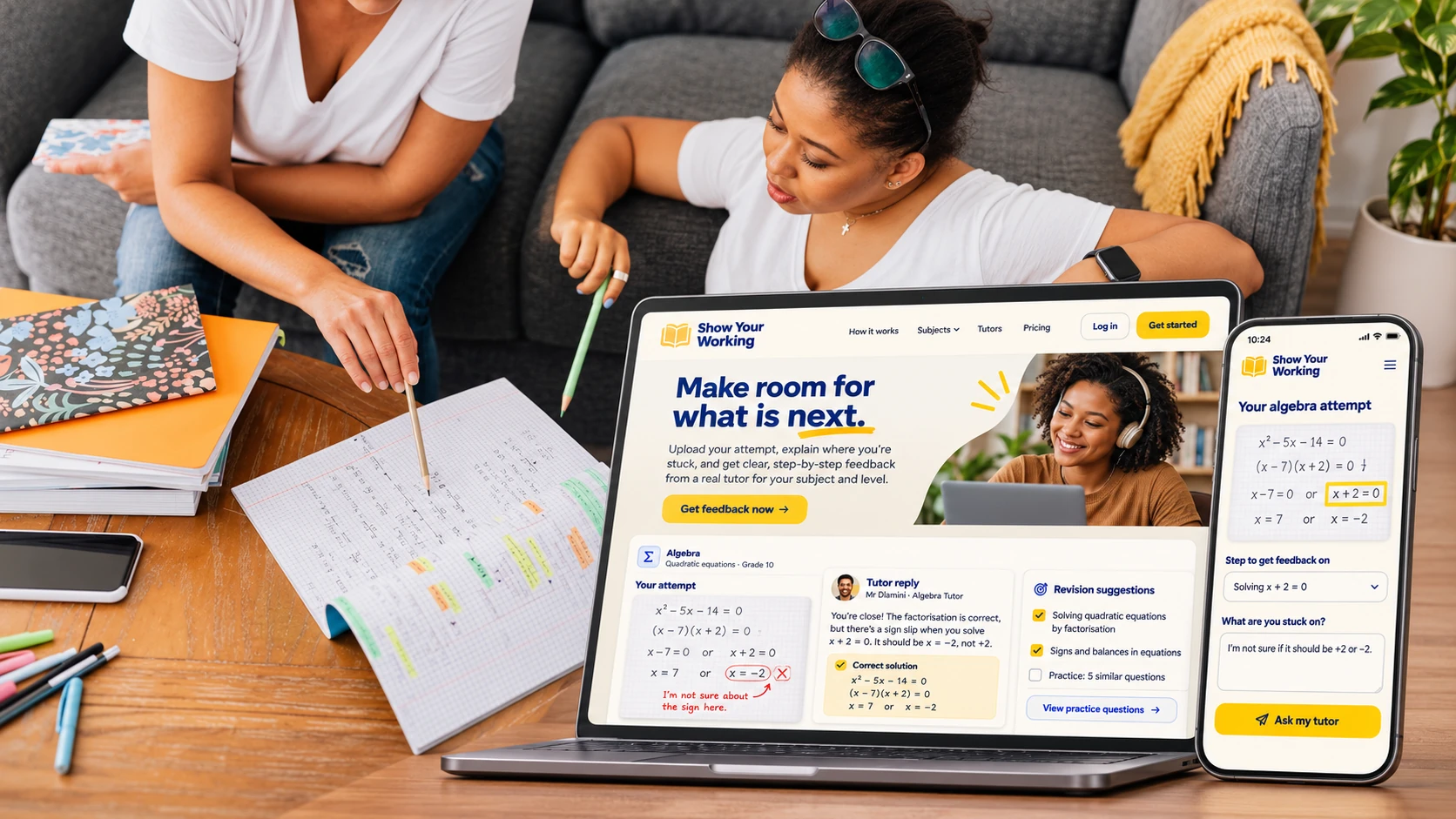
A student has tried the problem twice and cannot see where their reasoning breaks. They want a useful nudge, but a finished answer would hide the same gap. Your desk could let them share their attempt and receive feedback that points to the misunderstanding and invites another try.
A business you can
picture.
Create a guided feedback platform for a particular subject or age group. Learners submit their own attempt, explain where they are stuck and receive a structured response from a suitable tutor.
Who would be glad
you built it?
Students seeking clarification
Understand errors in their own attempt.
Families
Arrange bounded tutoring support.
Schools and tutors
Offer structured review between sessions.
Where the money
could come from.
Families or learners could buy a defined number of reviews, with schools purchasing an agreed group allowance. The price must cover tutor reading, explanation and follow-up boundaries. Limit submission size and complexity clearly so customers understand the service and reviewers have time to offer useful feedback.
The part you could
make your own.
The quality of the next question could be your advantage. Feedback that identifies a reasoning gap and asks the learner to try again may feel more helpful than a generic answer bank. Test the resulting revision, not just satisfaction.
An angle to test with the people you want to serve.Start with something
worth using.
Start with one subject and a defined submission format. Require the learner's attempt and question, then provide a reviewed explanation or guided next step. State response arrangements and limits before selling a feedback allowance.
- Learner attempts and questions
- Tutor assignment and response windows
- Feedback history and follow-up practice
Give the promise
something to stand on.
You need suitable tutors, clear response boundaries and an academic integrity policy. The service should help learners reason and revise, with age-appropriate communication and a manageable review workload for staff.
Protect learner information and set academic integrity rules. Where children participate, use appropriate guardian controls and tutor checks. Response times should match actual staffing.
Let a small beginning
teach you something.
Invite a small learner group to submit work they have already attempted. Ask tutors to explain one error without completing the assignment, then observe whether learners can revise the work themselves.
Does the feedback help the student make their own meaningful revision rather than simply copy a supplied answer?
Look for these signs
- Submissions include the learner's attempt
- Feedback targets the actual misunderstanding
- Students can explain their revision
A little more
clarity.
Can students submit assessed homework?
Set a clear policy that respects the learning setting. Feedback can focus on reasoning and understanding, but the service should not complete work for submission as the student's own or help evade assessment rules.
How quickly should feedback arrive?
Promise only a response arrangement your tutors can sustain. A defined turnaround and visible queue are more useful than an instant-help claim that leads to rushed or unavailable human review.
Paper is a related reference for tutoring services.
Now picture it
with your name on it.
Your people. Your priorities. The version you keep thinking about. Answer a few questions and leave with a starting plan you can keep.
Free to explore. No account or email needed for your starting plan.