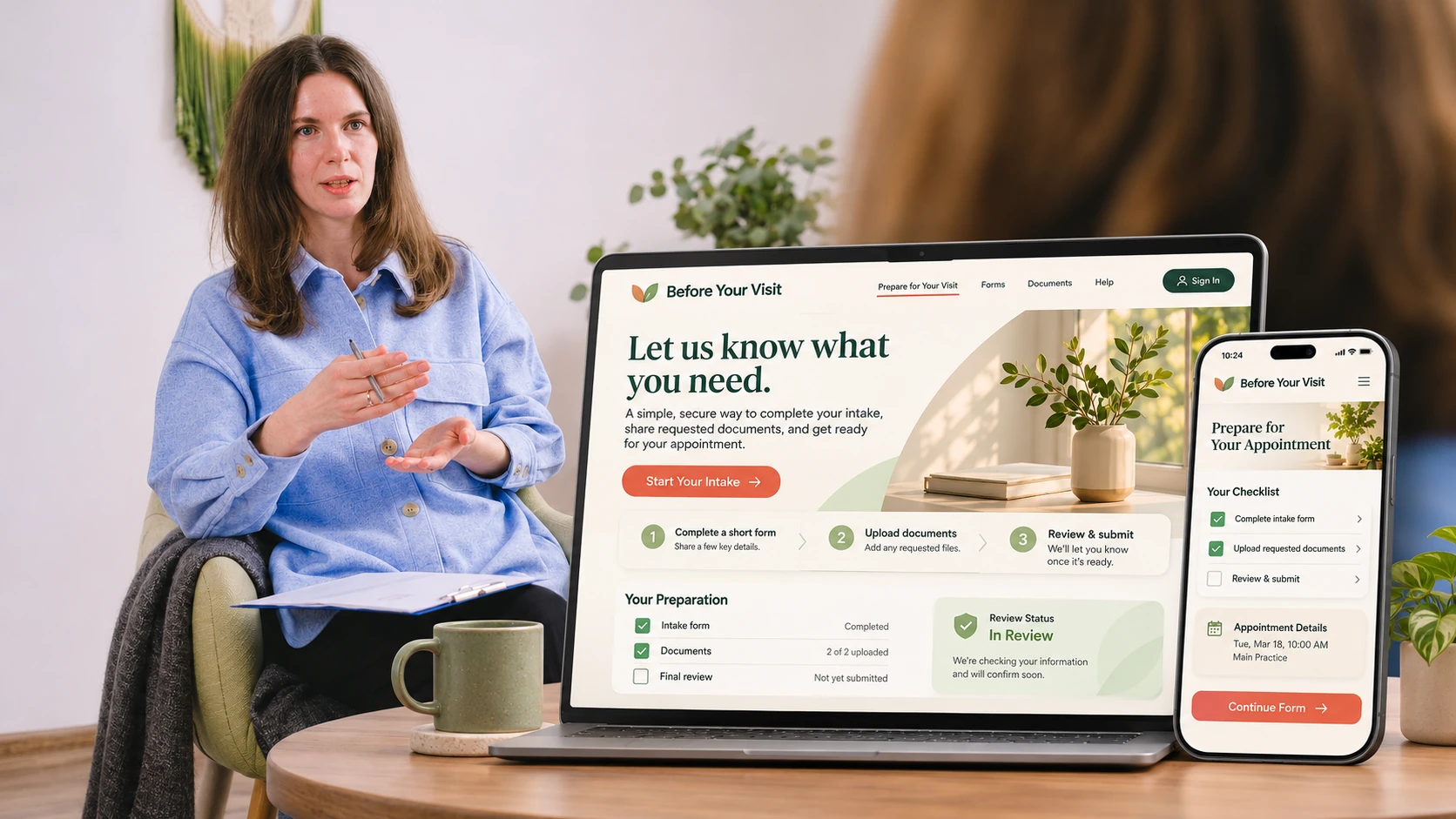
A patient completes a form, then is asked for the same details again because a required attachment never reached the right person. Your workspace could make the preparation process easier to understand and give staff a clear way to review what is complete before the visit.
A business you can
picture.
Offer intake software to a defined practice type. Use clear forms, document requests and review steps designed with the professionals who will use the information.
Who would be glad
you built it?
Patients preparing for appointments
Understand required forms and documents.
Practice administrators
Review completeness and route information.
Authorised clinicians
Access approved information within their workflow.
Where the money
could come from.
Practices could pay a subscription for an approved intake workflow and staff review tools, with form adaptation or integration separately scoped. Secure storage, maintenance and support create continuing costs. The fee buys administrative software and agreed services, not medical assessment or a promise that every appointment will require less time.
The part you could
make your own.
Clarity for the patient could be your edge. Plain questions, useful explanations and visible preparation status may reduce repeated requests. Test whether staff receive more usable information without making the form longer or more intrusive than necessary.
An angle to test with the people you want to serve.Start with something
worth using.
Choose one practice type and one approved intake sequence. Provide clear forms, document upload, completion status and staff review. Use sample data while testing, and keep clinical interpretation outside automated administrative checks.
- Accessible intake forms and file uploads
- Staff review and missing-information requests
- Consent records and controlled access
Give the promise
something to stand on.
You need close collaboration with the practice and careful control of sensitive information. Forms, access permissions, retention and review responsibilities should be agreed by the professionals who use the data, not improvised from a generic template.
Health-data protection, professional oversight and local requirements are fundamental. Avoid collecting information that has no defined purpose. Form submission must not imply a diagnosis or immediate clinical review.
Let a small beginning
teach you something.
Ask practice staff to identify a common preparation problem, then test a revised form with willing users using sample information. Observe comprehension and review handover before a supervised rollout to actual patients.
Can a patient understand what is needed and can authorised staff see which preparation items still require attention?
Look for these signs
- Questions are understandable to patients
- Missing information is clearly identified
- Review access matches authorised roles
A little more
clarity.
Can the form decide how urgent a patient's condition is?
That would require a separately designed and appropriately governed clinical process. A basic intake tool should not turn administrative answers into unsupported triage advice or imply that an urgent concern will be assessed through an ordinary form.
Should every form field be mandatory?
Only require information needed for the agreed purpose and stage. Allow clear explanations where a patient cannot answer, and let the practice decide how staff review incomplete information instead of blocking all progress unnecessarily.
Jotform is a reference for digital patient intake forms.
Now picture it
with your name on it.
Your people. Your priorities. The version you keep thinking about. Answer a few questions and leave with a starting plan you can keep.
Free to explore. No account or email needed for your starting plan.