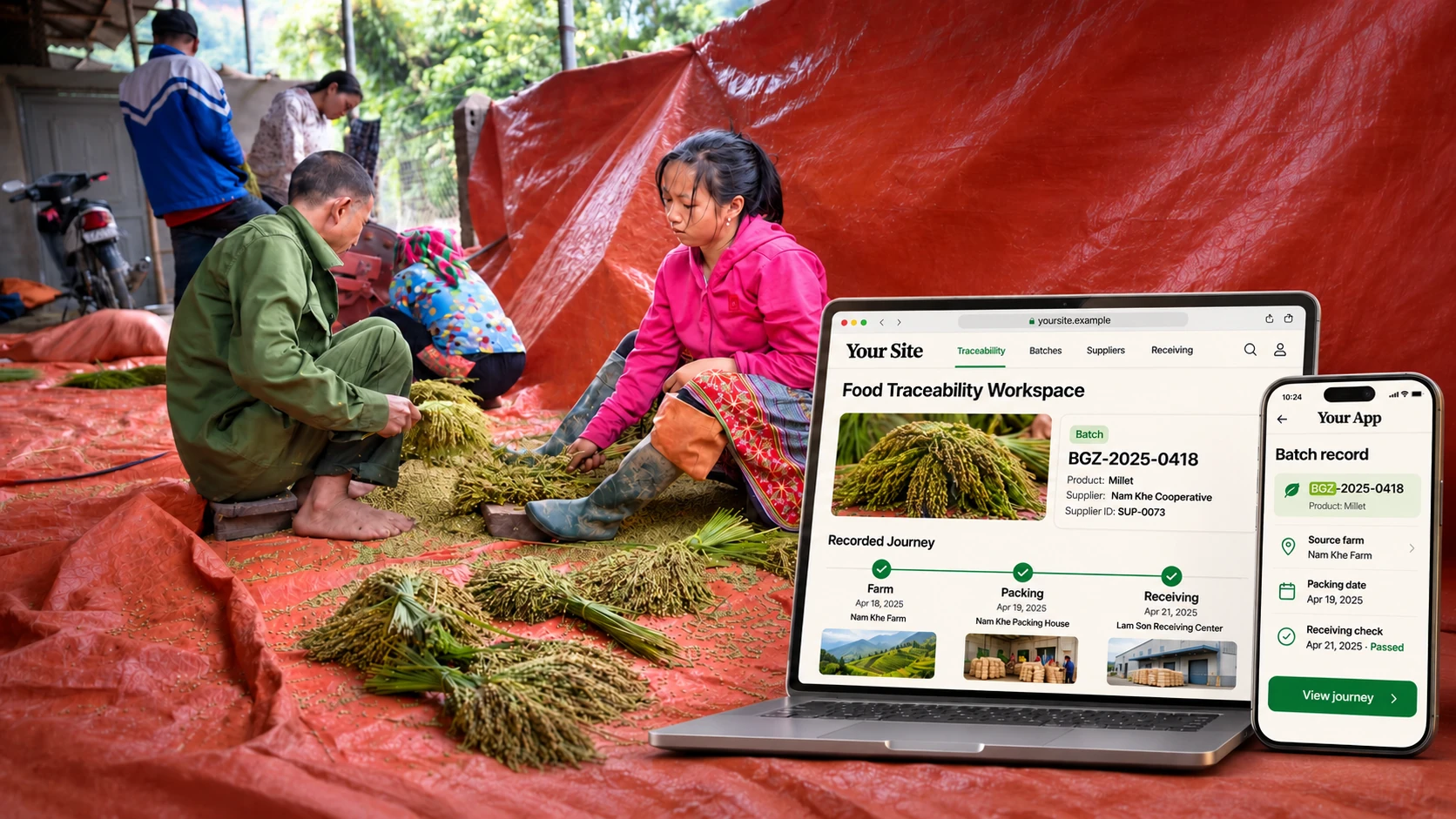
A buyer asks which incoming batch supplied a particular delivery. The answer exists, but it is scattered between packing sheets, messages and a driver’s receipt. Your workspace could help smaller suppliers connect those handovers, making a useful question easier to answer without pretending that a digital entry proves everything about the food.
A business you can
picture.
Offer traceability software for a defined food chain. Connect batch identifiers, supplier records and receiving events so authorised participants can investigate a product’s recorded journey.
Who would be glad
you built it?
Small processors
A connection between incoming materials and outgoing batches
Produce suppliers
Manageable handover records for buyers
Food buyers
A clearer route back to relevant supply evidence
Where the money
could come from.
A processor or buyer could pay for organisation access and a defined setup service. The fee supports record storage, training and maintenance, while complex integrations can be separately scoped. Price the record workflow you actually provide; a traceability tool should not be sold as an automatic food-safety certificate or a guarantee of product authenticity.
The part you could
make your own.
Your advantage could be a handover process small suppliers can maintain with the tools they already use. A simple missing-record queue may be more useful initially than a complex dashboard with incomplete data.
An angle to test with the people you want to serve.Start with something
worth using.
Choose one product chain and a short sequence of handovers. Record batch identifiers, quantities, dates and responsible parties. Test tracing an outgoing delivery back through the available records before adding integrations.
- Batch and supplier records
- Dispatch and receiving events
- Document links and exception reviews
Give the promise
something to stand on.
You need knowledge of a specific supply chain and the cooperation of the people recording handovers. Batch naming, corrections, missing entries and responsibility for investigation must be agreed in practice.
Traceability depends on accurate inputs and real operating controls. A digital record does not itself certify food safety or authenticity. Define corrections, missing information and responsibility for investigations.
Let a small beginning
teach you something.
Work with one willing supply chain on a real batch. Ask a buyer to raise a trace-back question, then follow the records together and identify exactly where the chain becomes uncertain.
Can the team trace an outgoing batch to its recorded inputs and clearly identify any missing handover evidence?
Look for these signs
- Batch identifiers remain consistent at handover
- Missing records are visible for follow-up
- Corrections preserve the earlier record
A little more
clarity.
Does a complete record prove food safety?
No. Records support traceability, while food safety depends on actual practices and appropriate controls. The system should make its evidence and limitations clear rather than implying certification.
What if a supplier uses paper records?
A first version can support a controlled handover from paper or photographs, provided someone checks and links the information. Avoid making a copied entry look independently verified.
FoodLogiQ is a reference for food supply traceability software.
Now picture it
with your name on it.
Your people. Your priorities. The version you keep thinking about. Answer a few questions and leave with a starting plan you can keep.
Free to explore. No account or email needed for your starting plan.