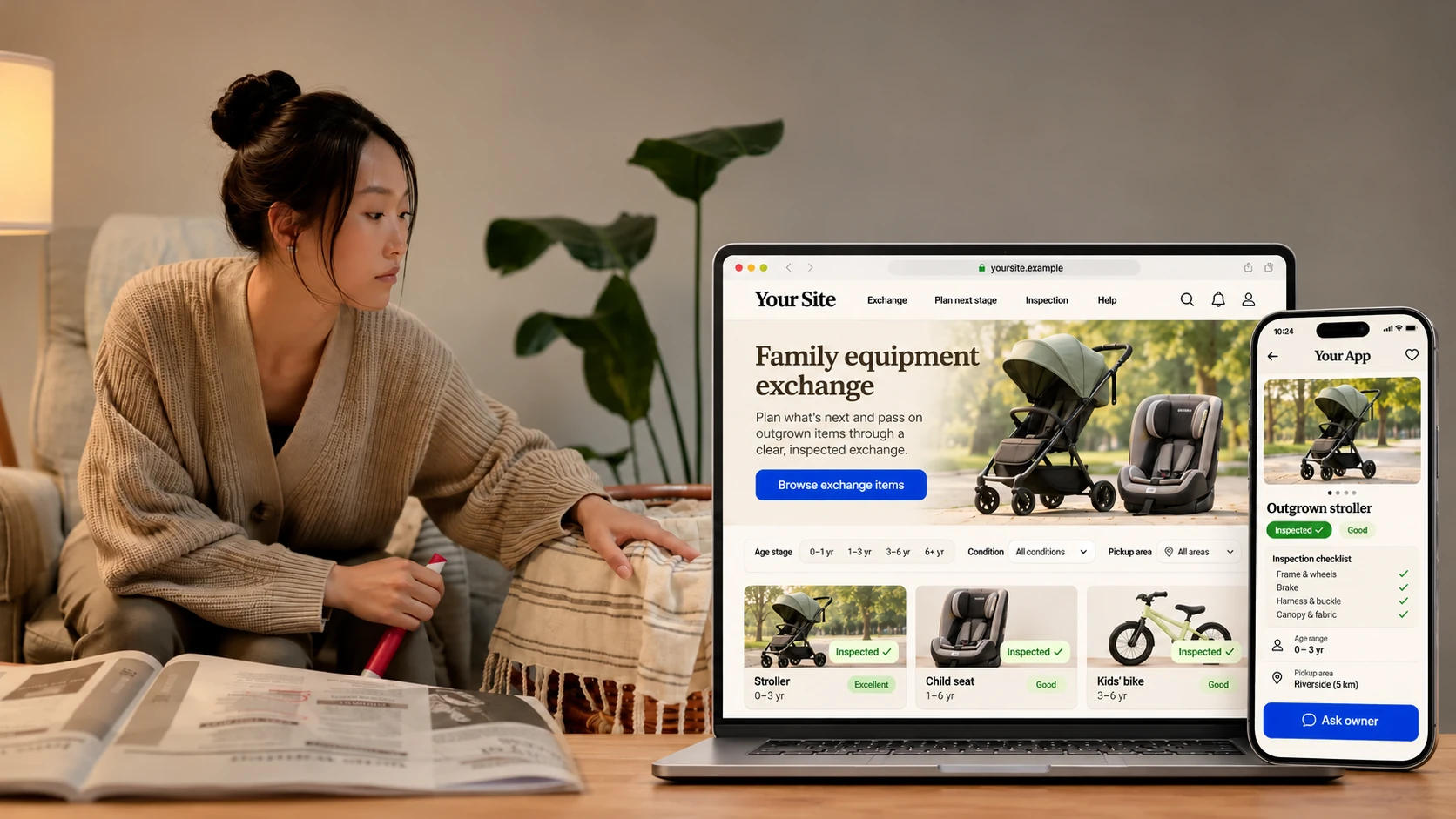
A family clears space for a child’s next stage and notices how much good equipment is already outgrown. Another family is searching for those same things in a hurry. Your service could connect the transitions, helping people plan ahead and understand an item’s condition before arranging a practical handover.
A business you can
picture.
Choose a suitable low-risk product category. Families list future needs and available items, while the operator checks descriptions and coordinates collection or a local exchange event.
Who would be glad
you built it?
Families preparing for a new stage
Suitable items available at a useful time
Households passing on outgrown gear
A manageable sale or exchange process
Community family groups
A structured way to coordinate appropriate local handovers
Where the money
could come from.
A disclosed fee on completed sales could support the exchange, with optional consignment help priced separately. Your share covers listing review, coordination and support. If you inspect items, explain exactly what that service checks. Deposits, delivery and failed handovers need clear terms so the commercial model does not rely on unresolved disagreements between families.
The part you could
make your own.
Your proposed edge is planning around a coming transition rather than waiting for an urgent search. A family could prepare a shortlist for the next stage while another knows when an item will become available.
An angle to test with the people you want to serve.Start with something
worth using.
Begin with a limited range of appropriate non-safety-critical items in one area. Capture condition, included parts and availability dates. Match planned needs and record the agreed collection and payment arrangements.
- Show the item's actual condition and history.
- Plan handovers around each family's timing.
- Explain inspection, collection and support arrangements.
Give the promise
something to stand on.
You need category knowledge and a dependable condition-review process. Choose items carefully, explain inspection limits and avoid treating used safety-critical products as suitable simply because a seller offers them.
Choose categories carefully and check applicable product restrictions. Do not treat used safety-critical equipment as suitable merely because a seller lists it; make inspection limits clear.
Let a small beginning
teach you something.
Work with a family group on one suitable item category. Ask households to state upcoming needs and expected availability, then trial a few handovers and review where condition or timing still caused uncertainty.
Does planning the transition help two families arrange a suitable item handover with clear condition and timing expectations?
Look for these signs
- Listings accurately describe parts and condition
- Handover dates fit both households
- Families understand inspection limits
A little more
clarity.
Can any children’s equipment be exchanged?
No. Select categories carefully and review applicable restrictions. Some used products require checks or handling beyond a simple marketplace, and an attractive listing should never imply guaranteed suitability.
What if the seller still needs the item longer?
Keep availability provisional until both sides confirm the handover. Provide an update and cancellation process so a planning feature does not become a false promise to the waiting family.
What should my first version focus on?
Start with the first test described here, then build around the part people actually use and would pay to keep.
Now picture it
with your name on it.
Your people. Your priorities. The version you keep thinking about. Answer a few questions and leave with a starting plan you can keep.
Free to explore. No account or email needed for your starting plan.