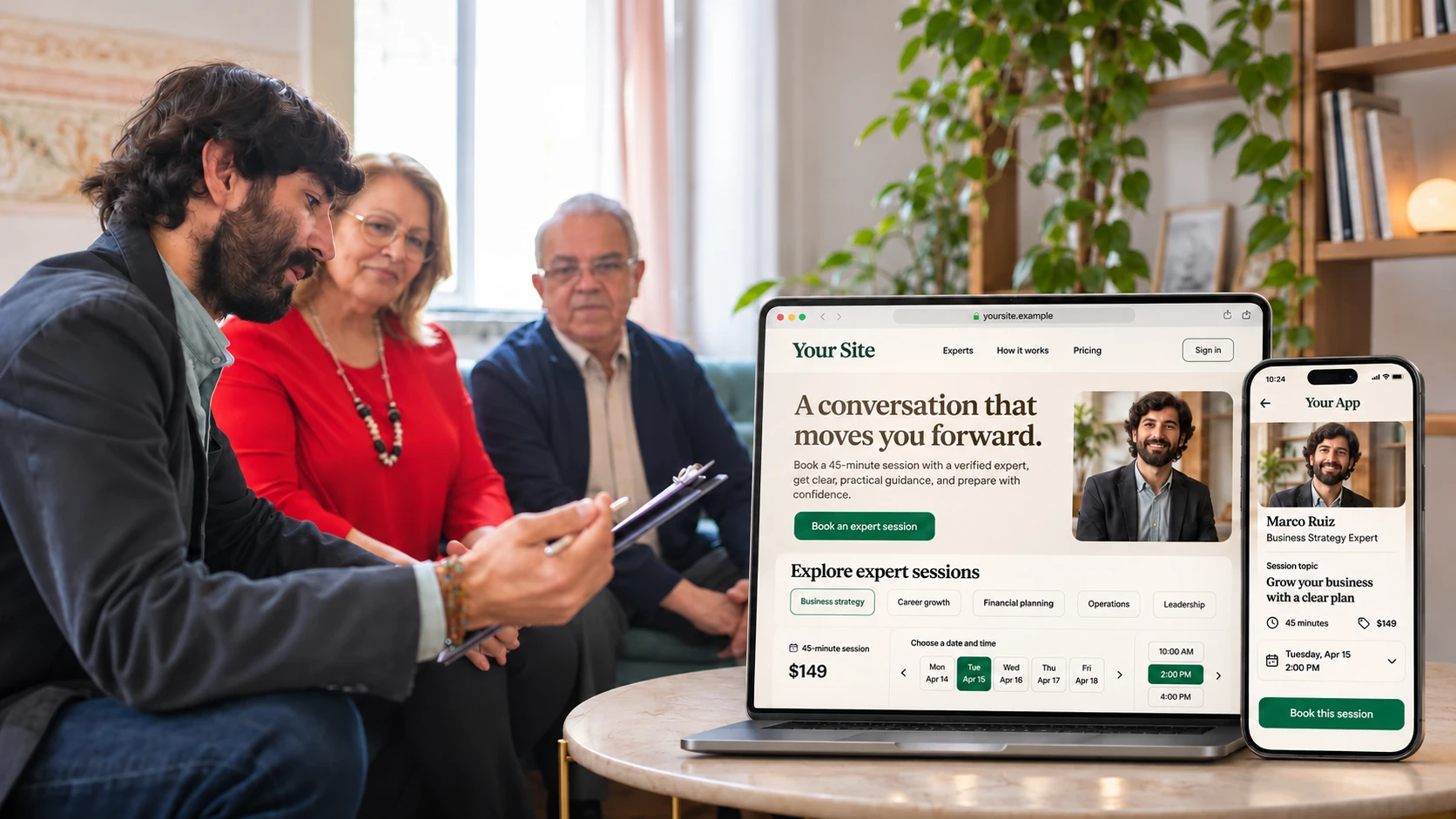
A retailer has three supplier quotes and no confidence about which questions to ask. They do not need an open-ended consulting relationship yet. Your booking service could offer a focused review with someone who understands the decision, so the customer knows what the session is for and what to bring.
A business you can
picture.
Begin with one professional or a small group in one field. Give each session a practical purpose and a realistic boundary.
Who would be glad
you built it?
Independent experts
Offer a bounded paid consultation.
Small business owners
Get help with a specific decision.
Professional teams
Organise sessions around defined expertise.
Where the money
could come from.
Customers pay for an agreed consultation or review package. A booking marketplace could retain a disclosed share, while an independent expert keeps the session revenue after costs. Preparation, follow-up, missed appointments and payment charges belong in the price; the calendar slot is only part of the service delivered.
The part you could
make your own.
A sharply defined outcome could make your expertise easier to buy. Test whether a practical session description, example questions and clear boundaries help customers choose confidently without implying that every decision has a guaranteed answer.
An angle to test with the people you want to serve.Start with something
worth using.
Start with one expert and one or two session types. Describe the question each session addresses, required preparation, duration, price and follow-up. Include rescheduling rules and a simple way to ask whether the offer fits.
- Explain the expert’s experience, session scope and price.
- Ask for the customer’s question before the meeting.
- Show availability and take a booking.
- Share agreed follow-up notes or resources securely.
Give the promise
something to stand on.
You need relevant experience, a clear professional scope and a way to prepare for each appointment. Your reputation depends on the usefulness of the conversation, not just filling the calendar.
Scheduling, no-shows, refunds and customer questions all need attention. Check experience claims before publishing profiles. Where advice is regulated, the expert still needs the appropriate qualifications and permissions.
Let a small beginning
teach you something.
Review questions people already bring to you. Invite suitable contacts to try a narrowly described paid session and ask afterwards what decision became clearer and what still needed another kind of support.
Can a prospective customer explain what they will receive and decide whether the session suits their situation?
Look for these signs
- Customers arrive with useful preparation
- Sessions stay within their stated scope
- Follow-up reflects the agreed deliverable
A little more
clarity.
How narrow should the first session be?
Choose a question you can responsibly help with in the available time. A supplier shortlist review is easier to assess than a promise to solve every part of running a business.
Can customers book any expert immediately?
Some requests need a fit check first. Let experts review the question and explain when another provider or a longer engagement is appropriate, especially where qualifications or professional boundaries matter.
Must I recruit a team of experts first?
No. One credible professional with a useful offer can test the model.
What if I already have a service website?
The booking experience could become a new paid offer within it, alongside your existing work.
Clarity connects people with experts through paid advice calls. It provides a reference for the broad model. Your own credibility, permissions and customer experience would support the offer.
Now picture it
with your name on it.
Your people. Your priorities. The version you keep thinking about. Answer a few questions and leave with a starting plan you can keep.
Free to explore. No account or email needed for your starting plan.