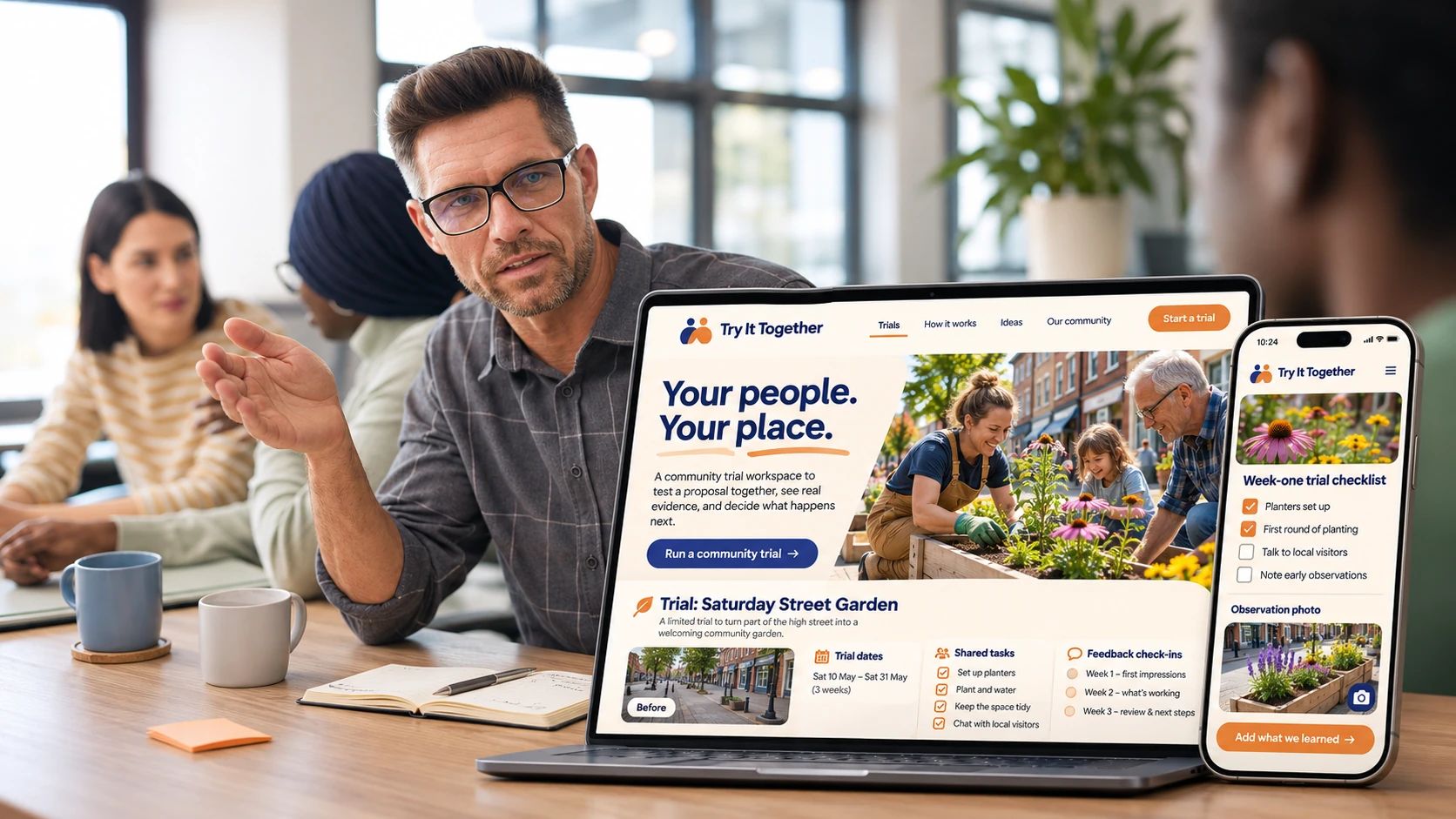
A group debates a new meeting time for weeks. Some expect better attendance; others worry about transport or family routines. Your service could help them try a manageable change with clear permission, listen to the people affected and make the next decision from an actual experience rather than assumptions alone.
A business you can
picture.
Start with an organisation and a reversible proposal. A facilitator defines the trial, obtains the necessary agreement, confirms participants and records what the group wants to observe during the limited period.
Who would be glad
you built it?
Community organisations
A structured way to trial a small proposed change
Participants affected by the proposal
Clear expectations and a way to give feedback
Umbrella associations
A practical support service for local decision-making
Where the money
could come from.
An organisation could pay a fixed facilitation fee for one trial package. The fee covers planning, participant communication, feedback organisation and a review meeting. Price that work directly. The service should not promise that a trial will prove the proposal successful or that a small participating group represents every person affected by a wider change.
The part you could
make your own.
Your angle could be turning a broad debate into a small experience people can discuss concretely. A trial may expose practical constraints that a preference poll misses, while leaving the final decision with the group.
An angle to test with the people you want to serve.Start with something
worth using.
Choose one reversible proposal, such as a session timetable. Agree the purpose, trial period, permissions and feedback questions. Record what happened and help the group review the evidence without turning the trial into a predetermined endorsement.
- Set the trial's scope, dates and responsibilities.
- Collect agreed observations and participant feedback.
- Review the evidence against the original questions.
Give the promise
something to stand on.
You need facilitation skills and respect for the group’s authority. Trials should be voluntary where appropriate, manageable to stop and honest about who participated and whose experience is still missing.
Participation, permissions and data use must be clear before the trial. Keep the change manageable, provide a way to stop and avoid treating a small group as representative of everyone affected.
Let a small beginning
teach you something.
Find an organisation already considering a modest, reversible change. Help it define what it needs to learn, run the agreed trial and compare the resulting discussion with the assumptions made beforehand.
Does the trial reveal useful practical experience, including objections, that helps the group decide what to do next?
Look for these signs
- Participants understand the trial’s purpose
- Feedback includes difficulties and missing perspectives
- The final decision refers to observed experience
A little more
clarity.
Does a successful small trial prove the whole proposal?
No. Record who participated, what conditions applied and what remains uncertain. The experience can inform a decision without being presented as proof for every setting or person.
Can the group stop early?
It should have a clear way to pause or stop when agreed conditions require it. Define that process before the trial so participation does not become an open-ended obligation.
What should my first version focus on?
Start with the first test described here, then build around the part people actually use and would pay to keep.
Now picture it
with your name on it.
Your people. Your priorities. The version you keep thinking about. Answer a few questions and leave with a starting plan you can keep.
Free to explore. No account or email needed for your starting plan.