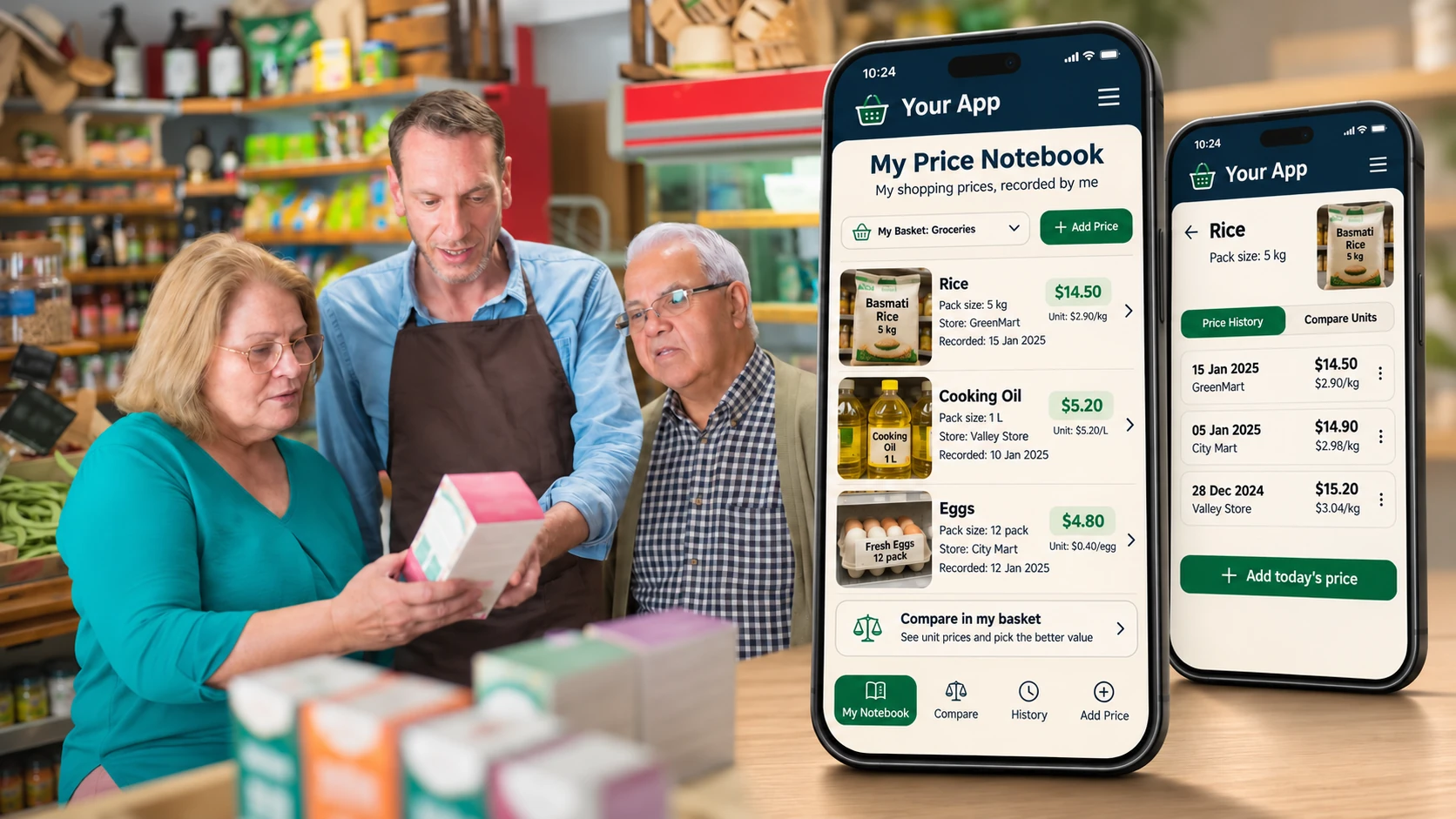
A shopper remembers a cheaper pack but cannot recall whether it was smaller or on a temporary offer. Your app could preserve price, shop, date and quantity together, allowing a like-for-like comparison of their own observations. It should make uncertainty visible instead of pretending that an old entry is today's price everywhere.
One useful moment.
A reason to open it.
A shopper records a price, date and pack size, checks the unit and compares it with a previous equivalent item. The app keeps both observation dates visible.
Who would be glad
you built it?
Careful household shoppers
Compare recorded pack sizes and prices.
Small buying groups
Share selected observations privately.
Independent buyers
Keep a history of familiar supplies.
A place in their life.
At the right moment.
Why it belongs on a phone
The shopper records a price beside the shelf and checks earlier entries on the same phone. Offline notes can be saved immediately.
A reason to come back
The next shop gives a reason to check and update an entry. A useful personal history grows through ordinary purchases.
Where the money
could come from.
A paid upgrade could offer longer histories, richer comparisons and private group sharing. The value depends on people maintaining useful records. Syncing, calculation testing and support have costs. Start with a focused audience that already compares purchases rather than assuming everyone wants to log every price.
The part you could
make your own.
Make record age and unit differences impossible to miss. That honesty could be more useful than a colourful cheapest-price badge based on incomplete or incomparable entries.
An angle to test with the people you want to serve.Start with something
worth using.
Start with price, date, shop and pack size, plus checked unit-price calculations. Group comparable items and show record age. Avoid claiming live price coverage without a maintained data source.
- Capture price, shop, date and pack size
- Confirm units and compare unit prices
- Group comparable items into a personal basket
- Review price history with clear record dates
Give the promise
something to stand on.
You need accurate unit handling and a clear distinction between user records and current merchant prices. Make corrections easy and keep any sponsored offer separate from the person's own observations.
Check unit calculations and let users correct recognition errors. Old entries do not prove current price or stock, and unlike products should not be silently treated as equivalent.
Let a small beginning
teach you something.
Ask willing shoppers to enter a few real observations and compare different pack sizes. Review unit mistakes, outdated records and whether the comparison helps them ask a more informed buying question.
Can the shopper compare equivalent quantities while recognising when the recorded price may no longer be current?
Look for these signs
- Units are confirmed before comparison.
- Every price retains its date.
- Unlike products are not silently treated as identical.
A little more
clarity.
Does the lowest unit price mean the best choice?
Not always. Quality, quantity needed, travel and waste can matter. Present the comparison clearly while leaving room for the shopper's own priorities and circumstances.
Can we promise a particular saving?
The notebook helps shoppers compare their own dated observations. What they spend still depends on current prices, the items they choose and other practical costs, so let the comparison support their judgement rather than promise a saving.
Does it promise the cheapest price in the area?
No. It compares the dated records users provide. It should show what is known and let the shopper confirm the current shelf price.
Now picture it
with your name on it.
Your people. Your priorities. The version you keep thinking about. Answer a few questions and leave with a starting plan you can keep.
Free to explore. No account or email needed for your starting plan.