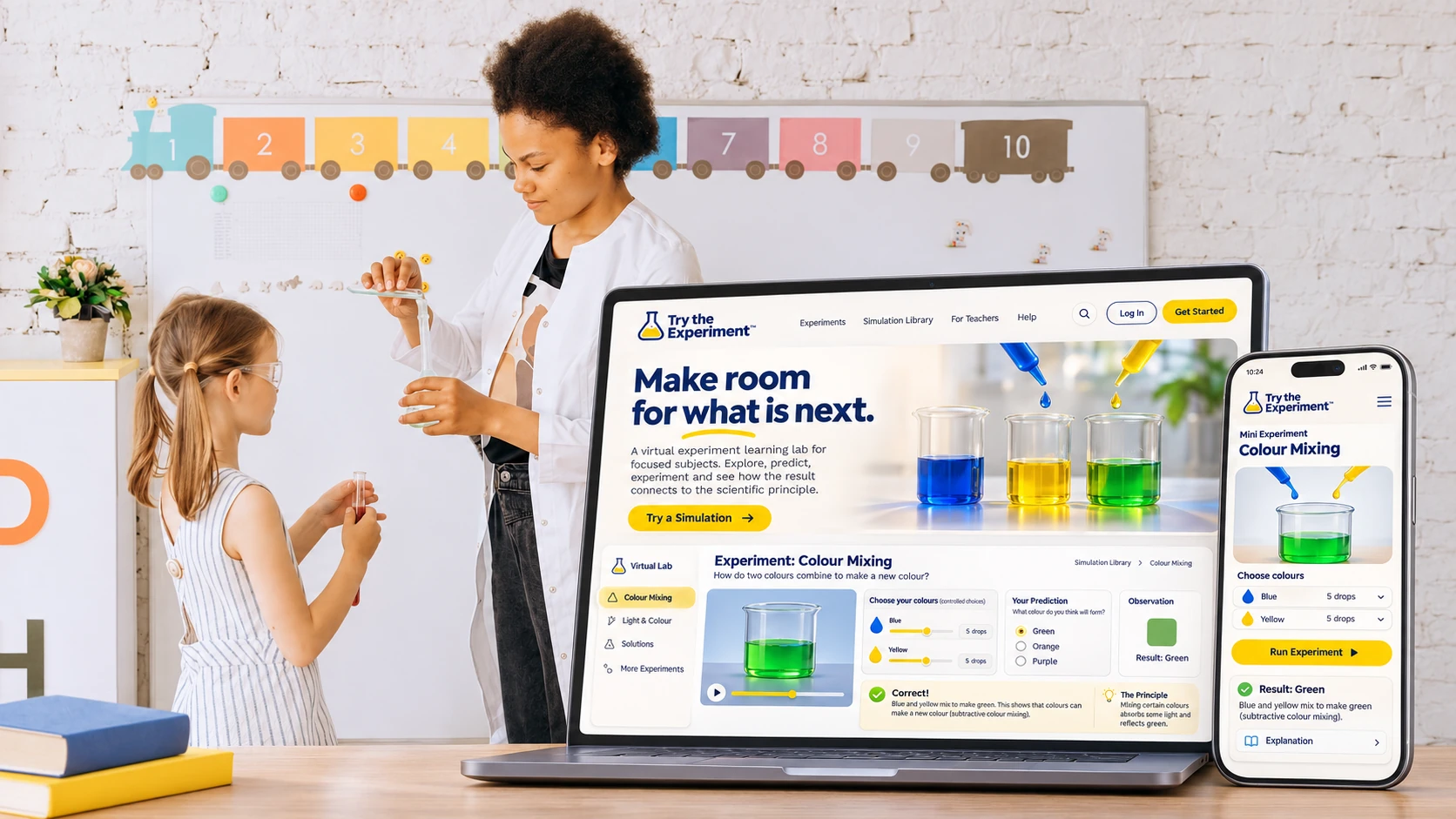
A learner can repeat the definition but cannot picture what changes when one condition is adjusted. Your virtual lab could let them move that variable, observe a result and explain what happened. The goal is a better learning conversation, with the model's limits visible alongside its possibilities.
A business you can
picture.
Create a simulation library for a focused subject. Give learners a question, controlled choices and feedback that connects the outcome to the principle they are studying.
Who would be glad
you built it?
Subject teachers
Demonstrate a specific difficult concept.
Learners
Explore cause and effect through practice.
Training providers
Offer repeatable guided simulations.
Where the money
could come from.
Schools or training providers could buy access to a verified subject collection. Specialist organisations may commission a particular simulation under a separate scope. Subject review, development, accessibility and updates require investment; define licence use and maintenance responsibilities so customers understand what continuing support their purchase includes.
The part you could
make your own.
A strong teaching sequence could be the distinction: predict, change, observe and explain. Test whether that structure resolves a known misconception more effectively than simply providing controls and leaving learners to guess what the result means.
An angle to test with the people you want to serve.Start with something
worth using.
Choose one concept and one experiment with controlled variables. Include a prediction question, observable result and explanation. Test the model and accessibility before building a large library of visually impressive but weakly explained simulations.
- Interactive experiment scenarios
- Guided questions and explanations
- Teacher assignments and learning records
Give the promise
something to stand on.
You need subject expertise and a way to verify the simulation's behaviour. Attractive animation is not enough; the model, learning prompts and explanation of limitations must all support the principle being taught.
Subject experts need to review the models and their limits. A simulation simplifies reality; explain what it includes and what it leaves out. Test accessibility and performance on the devices learners actually use.
Let a small beginning
teach you something.
Co-design a lesson with a subject teacher, then watch a small learner group use the simulation. Ask them to predict a result and explain a change, noting where the interaction helps or creates a misconception.
Can learners explain the relationship between a changed condition and the result rather than merely enjoy the animation?
Look for these signs
- Predictions lead to useful discussion
- Model limits are understood
- Teachers can connect activity to the lesson
A little more
clarity.
Does a virtual lab replace practical experience?
It can support particular concepts and offer repeatable exploration. Physical equipment, real materials or supervised practice may still be necessary. Describe what the simulation teaches and which experiences it cannot reproduce.
How realistic must the model be?
Accurate enough for the stated learning purpose, with assumptions clearly explained. Adding visual detail should not create a false impression that every real-world factor is included or that the result can guide practical decisions beyond the lesson.
Labster is a reference for virtual science laboratories.
Now picture it
with your name on it.
Your people. Your priorities. The version you keep thinking about. Answer a few questions and leave with a starting plan you can keep.
Free to explore. No account or email needed for your starting plan.