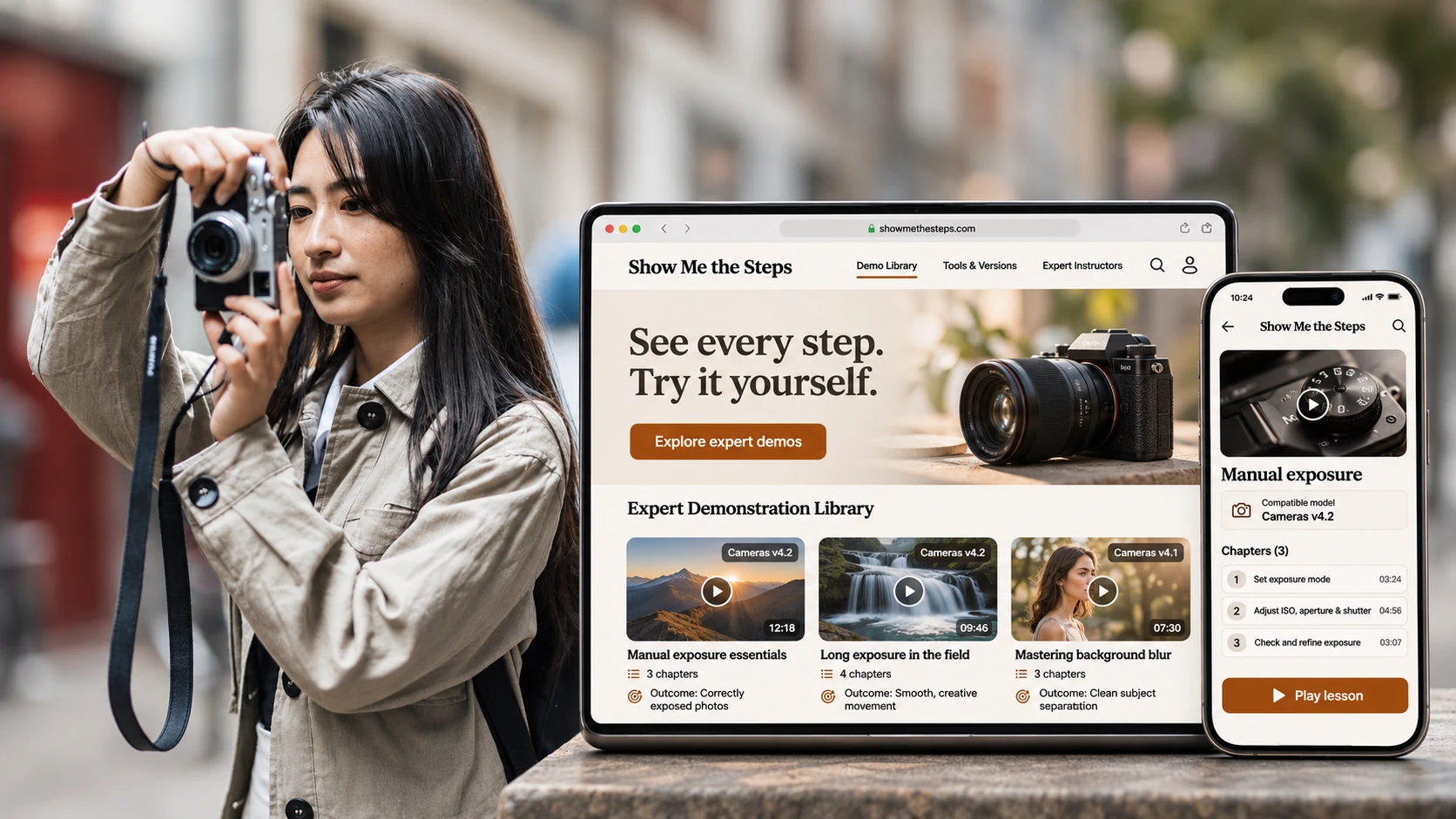
Someone pauses a tutorial because the button on screen no longer exists in their version of the tool. The explanation may be good, but the mismatch breaks the task. Your library could make those conditions visible, offering carefully maintained demonstrations people can choose with a clearer understanding of what they cover.
A business you can
picture.
Choose one professional tool category. Experts record short demonstrations, editors check the stated scope and each lesson carries a review date and a route to report changes.
Who would be glad
you built it?
People learning a practical software task
A demonstration matching their actual starting conditions
Small teams training staff
Current, focused material for recurring work
Specialist trainers
A clear format for maintained task demonstrations
Where the money
could come from.
Individuals or teams could pay for access to the maintained task library. Start with one defined customer group and a clear coverage promise. Fees must support recording, checking, updates and help with reported mismatches. Custom demonstrations can be separately commissioned, but the subscription should not imply that every possible task or future tool change is already covered.
The part you could
make your own.
Your proposed edge is useful precision and upkeep. A small demonstration that matches a current task may be more valuable to a user than a broad course whose examples leave them guessing at missing steps.
An angle to test with the people you want to serve.Start with something
worth using.
Choose one tool and a small group of recurring tasks. Publish short demonstrations with version, prerequisites and example files you can distribute. Mark outdated material clearly and provide a route to report mismatches.
- Search by the task the viewer wants to complete.
- State the version and assumptions clearly.
- Retire or update demonstrations when they stop matching.
Give the promise
something to stand on.
You need capable demonstrators and a deliberate review schedule. Use permissioned example data, record versions and dates, and avoid presenting completion as proof of professional competence or certification.
Secure rights to recordings and example data, protect client information and check the material before publication. Completion should not be presented as certification or proof of professional competence.
Let a small beginning
teach you something.
Ask a small team to identify tasks that repeatedly cause difficulty. Build a few reviewed demonstrations and observe willing users attempting the task from the stated starting point, recording any version or prerequisite mismatch.
Can a user with the stated starting conditions follow the demonstration and complete the intended task without unexplained gaps?
Look for these signs
- Demonstrations identify versions and prerequisites
- Reported mismatches lead to review
- Users can find the relevant task quickly
A little more
clarity.
What happens when the tool changes?
Mark affected material and review it before presenting it as current. Keep older versions available only with clear labels when they still serve users working in that environment.
Does watching a demonstration prove competence?
No. It supports learning a defined task. Any claim of assessed competence or professional qualification needs a separate appropriate process and should not be implied by viewing history.
What should my first version focus on?
Start with the first test described here, then build around the part people actually use and would pay to keep.
Now picture it
with your name on it.
Your people. Your priorities. The version you keep thinking about. Answer a few questions and leave with a starting plan you can keep.
Free to explore. No account or email needed for your starting plan.