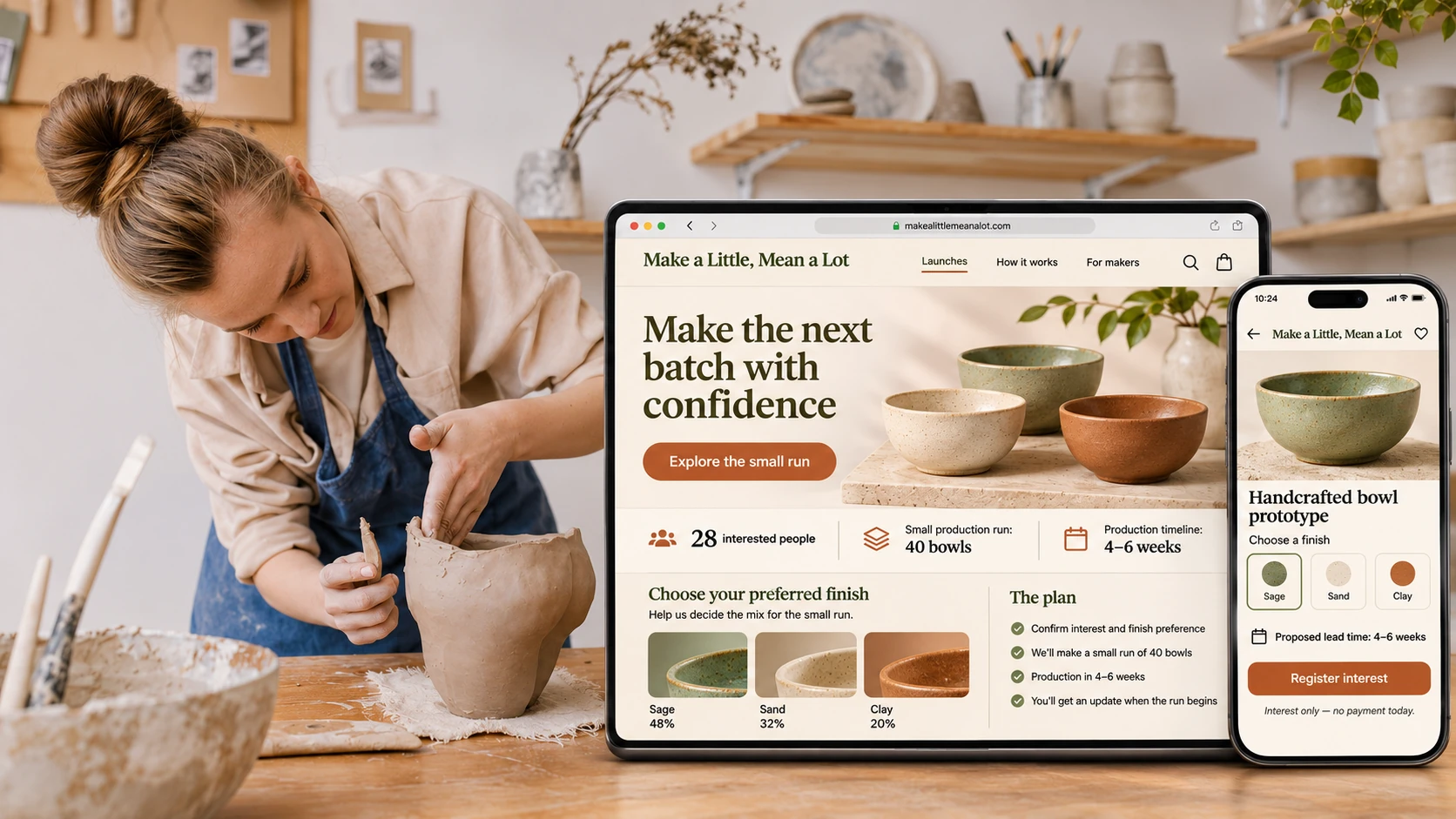
A maker has a promising design and a notebook full of encouraging comments, but making the first batch still feels like a leap. Your service could help turn interest into a clearer question: which version would people actually commit to, under what delivery terms, and is the proposed run workable for the maker?
A business you can
picture.
Focus on one maker category. A campaign explains the product, available variations and production conditions; expressions of interest remain separate from confirmed orders and accepted payment terms.
Who would be glad
you built it?
Independent makers
A structured way to test a defined production offer
Early customers
Clear product details and honest fulfilment expectations
Small creative studios
A practical record of options and confirmed commitments
Where the money
could come from.
A maker could pay a campaign preparation fee for a defined launch page and order-interest process. If confirmed orders are handled, a disclosed transaction share can be agreed separately. Revenue must cover preparation, payment work and support. Customer money and production obligations need clear terms; a successful-looking campaign is not evidence that fulfilment will be effortless.
The part you could
make your own.
Your possible difference is testing a production decision, such as material or finish, with a real offer. The maker learns something useful for the batch instead of collecting applause that cannot guide a commitment.
An angle to test with the people you want to serve.Start with something
worth using.
Choose one maker and one proposed batch. Show a finished sample or accurately labelled prototype, offer a small set of options and explain the commitment process. Define what happens if the run does not proceed.
- Present a limited product run and its options.
- Collect interest before confirming production.
- Communicate the agreed timeline and progress.
Give the promise
something to stand on.
You need maker relationships and an understanding of production limits. The service must distinguish enthusiasm from orders and keep delays, cancellation terms and customer updates tied to the actual production plan.
Make fulfilment, delays and cancellation arrangements clear. The operator needs a realistic understanding of production capacity, customer support and what happens when the proposed run does not proceed.
Let a small beginning
teach you something.
Work with a maker who can show a credible sample and explain production capacity. Present the bounded offer to a relevant consenting audience, then review commitments, questions and costs before deciding whether to produce.
Do enough customers make the defined commitment for a batch the maker can realistically produce and support?
Look for these signs
- Interest is distinguished from confirmed orders
- Customers understand the fulfilment conditions
- Production decisions use actual commitment information
A little more
clarity.
Does a lot of interest mean we should manufacture?
Not on its own. Examine the specific commitments, production costs and delivery capability. The platform should help the maker decide, not turn likes into a claim of proven demand.
What if the batch cannot go ahead?
Explain that possibility before taking commitments. State the cancellation and refund process, who is responsible and how customers will receive updates if the production decision changes.
What should my first version focus on?
Start with the first test described here, then build around the part people actually use and would pay to keep.
Now picture it
with your name on it.
Your people. Your priorities. The version you keep thinking about. Answer a few questions and leave with a starting plan you can keep.
Free to explore. No account or email needed for your starting plan.