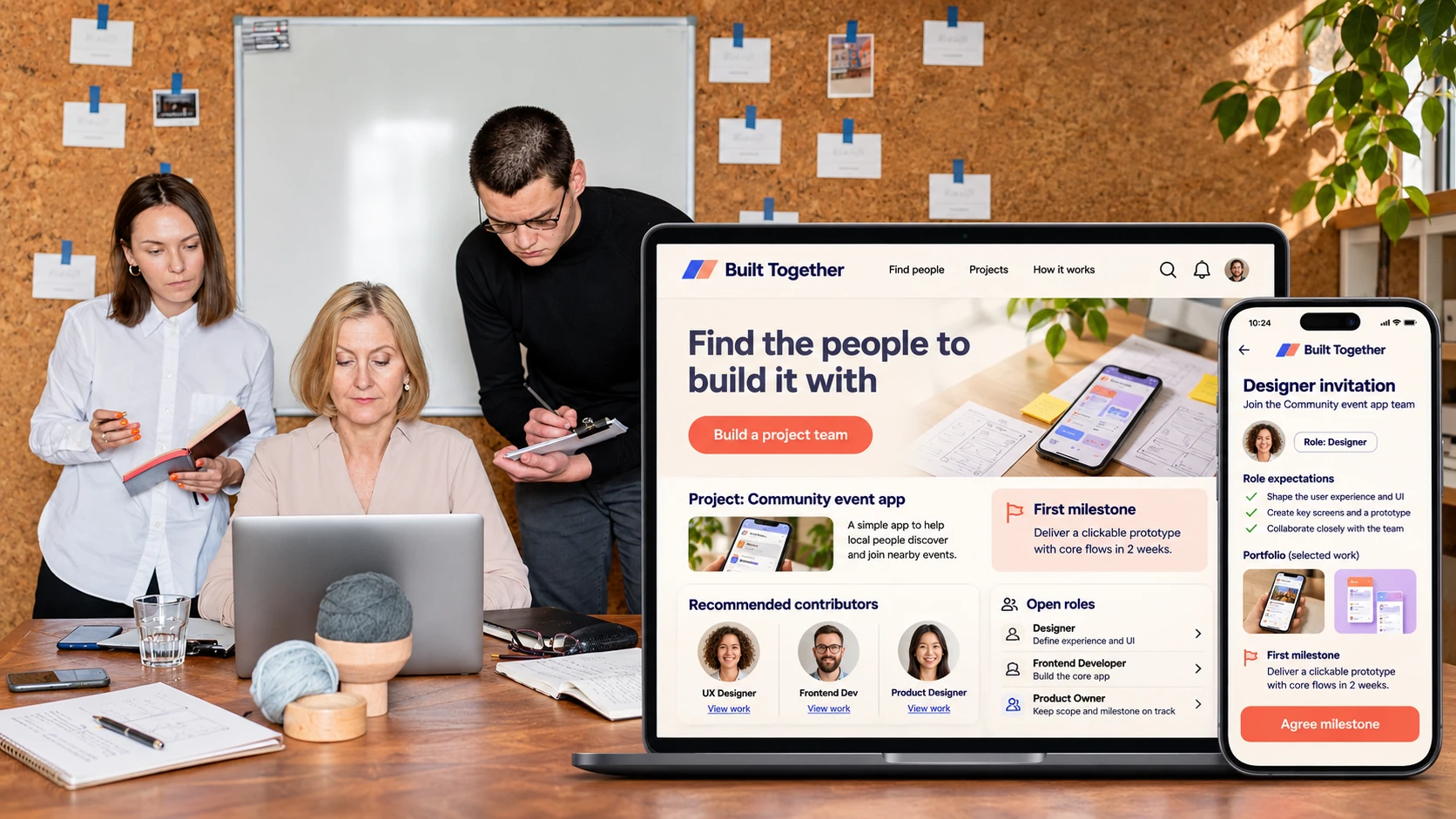
A founder has a promising store concept, a designer has the visual skill and a developer can build it. None knows whether they would work well together. Your service could turn that uncertain introduction into a defined, paid first task with responsibilities everyone understands.
A business you can
picture.
Begin with one kind of project, such as launching an online store. Keep introductions supervised while you learn which combinations work.
Who would be glad
you built it?
First-time founders
Find complementary skills for a bounded project.
Independent specialists
Join work with clear responsibilities.
Small agencies
Assemble partners for specific delivery needs.
Where the money
could come from.
A project owner could pay a planning and coordination fee for a defined team setup and milestone. Keep specialist compensation separate and transparent. Your margin must support scoping, introductions and resolving coordination problems; a successful introduction does not eliminate the work of helping the first engagement run clearly.
The part you could
make your own.
A possible advantage is the quality of the first collaboration. Scope templates for one project type, explicit roles and a fair paid trial could give founders more confidence than choosing profiles from a very broad directory.
An angle to test with the people you want to serve.Start with something
worth using.
Focus on one project type, collect skills and availability, and manually recommend a small team. Provide a shared brief, role agreement and first milestone before building automated matching or a broad talent marketplace.
- Turn a project into clear roles and responsibilities.
- Show relevant work samples and availability.
- Agree a small paid trial with specific deliverables.
- Keep decisions, tasks and handovers in one workspace.
Give the promise
something to stand on.
You need judgement about project scope and working relationships, not just a directory of profiles. Early coordination may be hands-on, particularly when expectations differ or a team member cannot continue.
Expect onboarding, support and occasional disputes. Explain what any verification actually checks. Agree fees, ownership, confidentiality and unfinished-work arrangements in writing. A profile is useful evidence, not a guarantee of competence.
Let a small beginning
teach you something.
Ask founders with a defined near-term project to describe the first deliverable. Introduce a carefully selected pair of specialists and observe the planning conversation, with permission, before encouraging a larger commitment.
Does a paid first task reveal enough about communication and delivery to support a larger collaboration?
Look for these signs
- Roles are agreed before work starts
- Milestones finish with fewer scope disputes
- Teams choose to work together again
A little more
clarity.
Does the platform employ the team?
Decide and explain who contracts with whom. A coordination service, agency and employment arrangement create different responsibilities. Customers and specialists should understand payment, ownership and dispute handling before accepting a project.
Can newcomers participate without a long portfolio?
A bounded paid task can reveal relevant ability and working habits. Use clear selection criteria and reasonable evidence, rather than demanding extensive unpaid trial work or treating reputation as the only route in.
Would an algorithm choose the team?
It could suggest options and explain why they match. The project owner should make the final choice.
Contra connects independent professionals and clients and supports project workflows. It is an adjacent reference; this concept focuses on complementary small teams and their first shared milestone.
Now picture it
with your name on it.
Your people. Your priorities. The version you keep thinking about. Answer a few questions and leave with a starting plan you can keep.
Free to explore. No account or email needed for your starting plan.