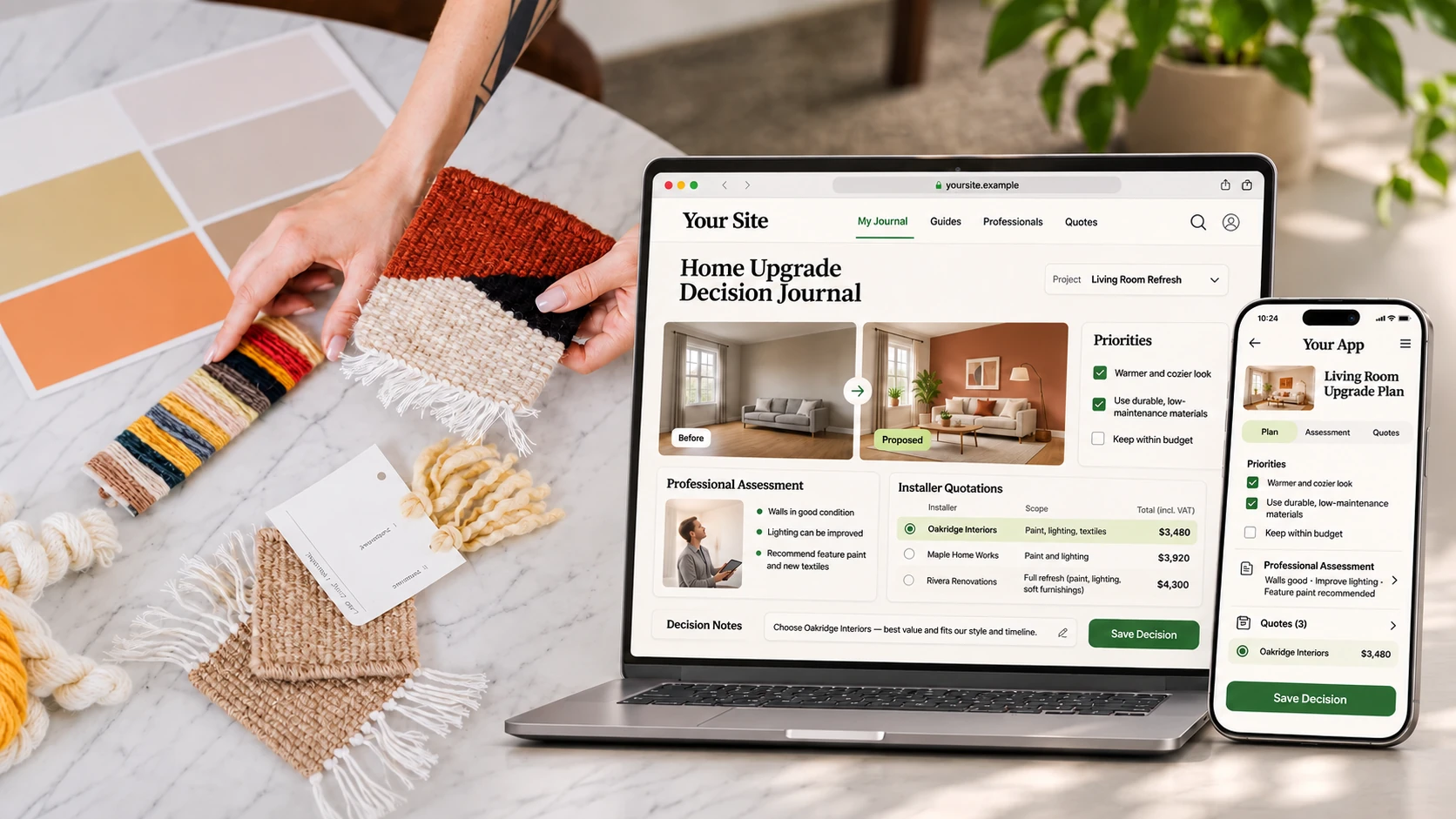
A household starts with a simple wish: make one room easier to use in the evening. Soon the conversation becomes products, quotations and conflicting suggestions. Your service could preserve the original goal, helping people compare proposals against the daily experience they want instead of losing it inside a growing list of purchases.
A business you can
picture.
Choose a defined class of home improvement. The household records its concerns, qualified providers assess the situation and the workspace compares scoped proposals using the same questions.
Who would be glad
you built it?
Households considering an improvement
A clear record of needs, options and decisions
Independent home advisers
A structured brief based on lived experience
Installers or designers
Context for the problem their proposal should address
Where the money
could come from.
Households could buy a guided planning package covering one defined problem and review session. The fee pays for interviews, organisation and decision support. Technical assessments and installation remain separately contracted. If providers pay to participate, disclose that relationship so the household understands whether a suggested option reflects independent advice or a commercial arrangement.
The part you could
make your own.
Your proposed edge is continuity from the first discomfort to the lived result. Keeping the original goal visible could help the household notice when an attractive proposal solves a different problem.
An angle to test with the people you want to serve.Start with something
worth using.
Focus on one room or everyday problem. Record the household’s goals, existing conditions, proposed options and unanswered questions. Provide a comparison view and a place to revisit the result after any work.
- Describe the household's practical priorities.
- Keep assessments and quotations beside each option.
- Record the chosen work and later observations.
Give the promise
something to stand on.
You need listening and planning skills, plus access to appropriate technical professionals. Keep costs and outcome estimates tied to assumptions and avoid implying that a general planning journal determines suitability.
Technical suitability, permissions and installation require appropriate professionals. Estimates should show assumptions, and the service should avoid promising savings or comfort outcomes before assessment.
Let a small beginning
teach you something.
Invite a household already considering a small upgrade. Capture the starting concern before reviewing quotations, then ask the household and a suitable professional which questions the journal makes easier to resolve.
Can the household explain how each option addresses its original concern and what still needs professional assessment?
Look for these signs
- Options remain linked to household goals
- Estimates identify assumptions and exclusions
- The completed result can be reviewed against the original need
A little more
clarity.
Does the journal recommend technical products automatically?
The first version should organise goals and questions. Technical suitability requires appropriate assessment, and any recommendation should explain its basis rather than present a generic product as the answer.
Can we promise lower bills or better comfort?
Only make a specific claim when suitable evidence and assessment support it. The planning service can help define what to measure without promising an outcome before the work is evaluated.
What should my first version focus on?
Start with the first test described here, then build around the part people actually use and would pay to keep.
Now picture it
with your name on it.
Your people. Your priorities. The version you keep thinking about. Answer a few questions and leave with a starting plan you can keep.
Free to explore. No account or email needed for your starting plan.