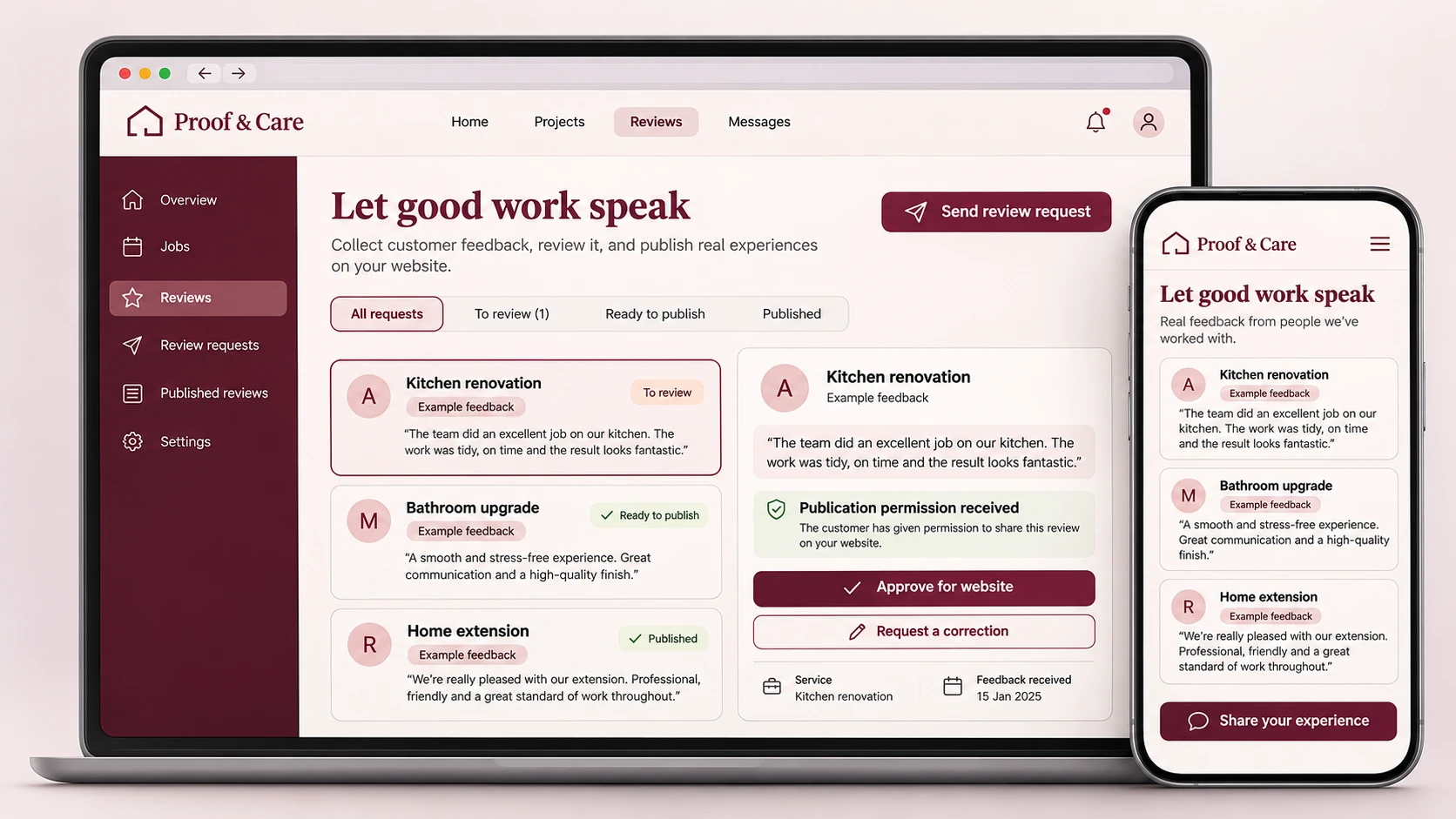
A visitor likes your offer but wonders what it feels like after paying. A thoughtful testimonial can answer a small part of that uncertainty when its context is clear. Your feature could collect and publish permissioned feedback about actual experiences, with room for corrections and no invented praise filling the gaps.
Visitors see your own claims about the service but have little context from people who have experienced the work themselves.
Permissioned feedback describes real experiences with useful context, giving visitors another perspective while preserving the customer's intended meaning.
Where it could
make a difference.
Service businesses
Show what a client valued in the experience.
Product brands
Present relevant customer feedback.
Hospitality providers
Help visitors understand a real stay or visit.
Useful on: Business website, Online store, Booking website.
What this could mean
for your business.
Relevant feedback can support trust and help visitors judge whether your offer fits them. It does not guarantee the same outcome for everyone. Review how customers use the information and the questions it resolves, while including the effort of requests, permissions and moderation in the feature's upkeep.
Start with something
worth using.
Start with a simple feedback request, context and permission. Publish a small relevant selection with accurate attribution. Add ratings or external review connections only when their source and display rules are clear.
- A feedback request route
- Context and publication permission
- A review and correction process
Give the promise
something to stand on.
You need authentic feedback records, publication permission and a responsible reviewer. Preserve the meaning of what was said and avoid presenting one person's experience as a result every customer will receive.
Decide how feedback is checked, moderated and updated. Show verification labels only when the underlying process supports them, and explain any incentive to the reviewer.
- Genuine feedback records
- Publication permissions
- Moderation responsibility
How it fits what you already have
Check feedback sources, attribution, publication permissions and moderation ownership. If importing reviews, verify the available connection and display terms, and ensure changes or removals can be reflected accurately on your site.
Let a small beginning
teach you something.
Invite recent customers to share honest feedback without prescribing praise. Ask prospective visitors what the published comments help them understand and whether the context feels sufficient to assess relevance.
Can a visitor understand whose experience is being described and why it is relevant to the service they are considering?
Look for these signs
- Published feedback has a real source.
- Permission and context are recorded.
- Corrections reach the responsible reviewer.
A little more
clarity.
Can we shorten a long review?
You can use a faithful excerpt with permission where appropriate, but it should not change the meaning. Keep the original record and avoid editing criticism into apparent praise.
Should we hide every negative comment?
A clear review and moderation policy is more useful than pretending no difficulty occurs. Handle inappropriate material separately from honest criticism and give your team a way to respond thoughtfully.
Could this work with my existing website?
We would check how your current website is built, what it already does and which services need to connect. That helps us choose a suitable addition and avoid paying twice for something you already have.
What would this change
in your business?
Your customers. Your working day. The part you would love to make easier. Answer a few questions and leave with a starting plan you can keep.
Free to explore. No account or email needed for your starting plan.