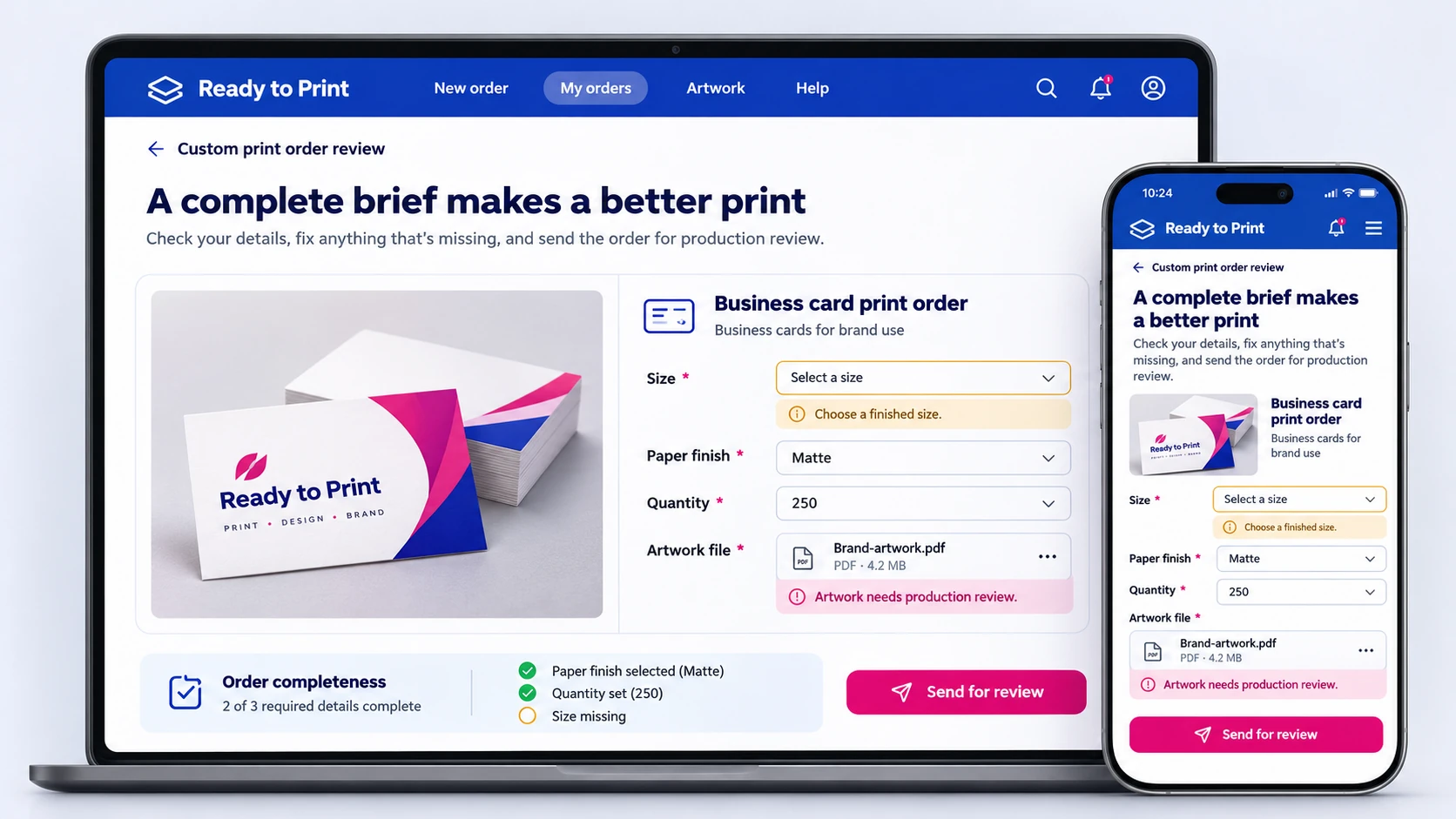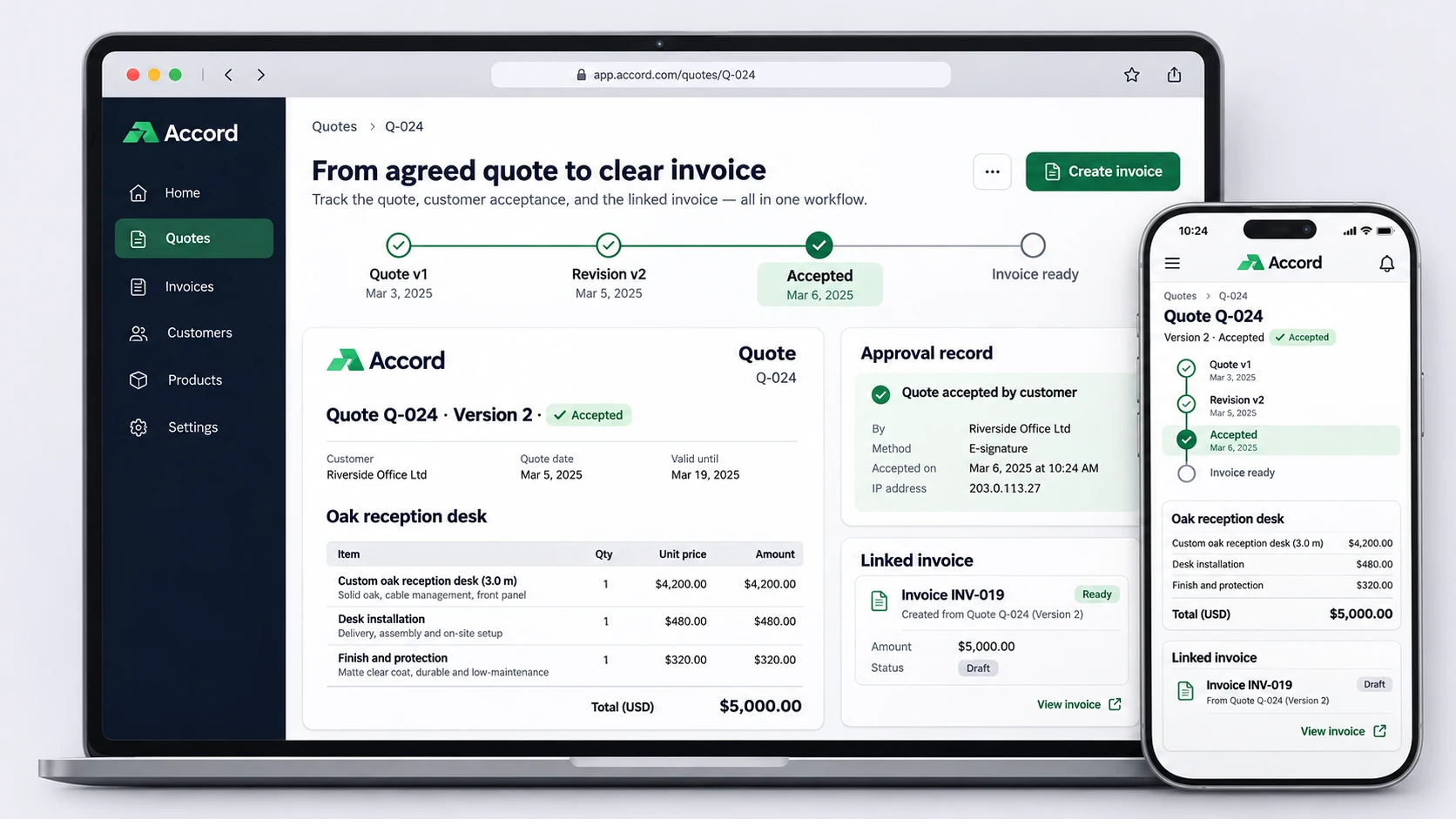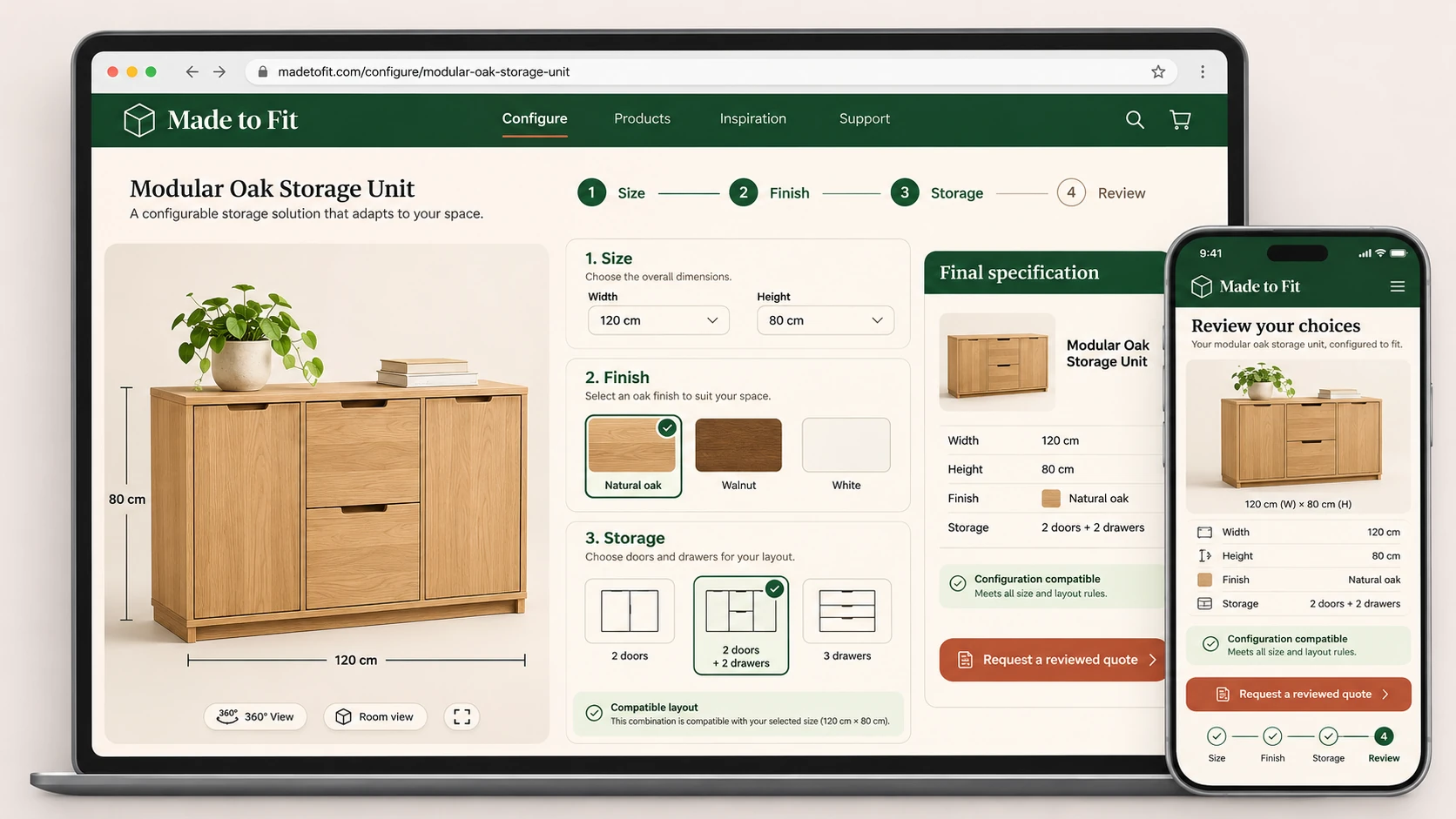
A customer wants a custom desk but cannot translate a long list of sizes, finishes and options into a confident request. A configurator could guide the important choices and show which combinations fit together. It should leave them with a clear specification, while unusual requirements still have a route to a knowledgeable person.
Customers interpret a long price list and send incomplete custom requests, leaving your team to reconstruct the intended combination through messages.
Guided choices explain compatibility and produce a clear specification, with an honest distinction between a confirmed offer and a request needing review.
Where it could
make a difference.
Custom product makers
Collect compatible options in a usable brief.
Equipment suppliers
Guide buyers through meaningful specifications.
Package-based services
Explain what changes between combinations.
Useful on: Online store, Service website, Supplier website.
What this could mean
for your business.
A configurator can support considered sales and reduce repeated option-gathering conversations. Its value depends on accurate rules and a deliverable offer. Review completed specifications, corrections and fulfilment questions alongside sales, including the effort required to maintain prices and available combinations.
Start with something
worth using.
Start with a bounded set of options and compatibility rules. Show the effect of each choice and a final summary. Keep unusual combinations as review requests rather than silently allowing an unfulfillable order.
- Meaningful option steps
- Compatibility rules
- A clear final specification
Give the promise
something to stand on.
You need accurate option rules, pricing ownership and a review process for exceptions. Decide whether the final result is a firm offer, an estimate or a specification awaiting your team's confirmation.
Define which combinations are possible and how prices are calculated. If the final price needs review, label the result as an estimate or request rather than a confirmed commitment.
- Accurate option rules
- Pricing responsibility
- A review route for exceptions
How it fits what you already have
Check option data, pricing, stock or capacity and order records. Define the authoritative rules and ensure the final specification reaches production or sales unchanged, including how exceptions and later revisions are handled.
Let a small beginning
teach you something.
Ask willing customers to configure a realistic example, then have your delivery team interpret the result. Identify missing details, incompatible choices and points where the wording caused a mistaken expectation.
Can the customer create a suitable specification and understand which parts are confirmed and which still need your team's review?
Look for these signs
- Invalid combinations receive useful explanations.
- The summary preserves every meaningful choice.
- Staff can fulfil or review the specification.
A little more
clarity.
Must the price update after every choice?
Only where the pricing method supports a meaningful result. A clear estimate or request-for-quote summary can be better than displaying a precise number your team cannot honour.
Can customers request something outside the options?
Yes, through a separate enquiry route. Make it clear that a custom request needs review rather than forcing them to choose an inaccurate standard combination.
Could this work with my existing website?
We would check how your current website is built, what it already does and which services need to connect. That helps us choose a suitable addition and avoid paying twice for something you already have.
What would this change
in your business?
Your customers. Your working day. The part you would love to make easier. Answer a few questions and leave with a starting plan you can keep.
Free to explore. No account or email needed for your starting plan.